
Selecting the appropriate chuck for machining tasks is crucial for ensuring efficiency, precision, and safety in manufacturing processes. The choice between 2-jaw, 3-jaw, and 4-jaw chucks depends on the specific requirements of the workpiece and the machining operation. This report provides a comprehensive analysis of each type of chuck, their advantages, disadvantages, and suitable applications, helping machinists make informed decisions.
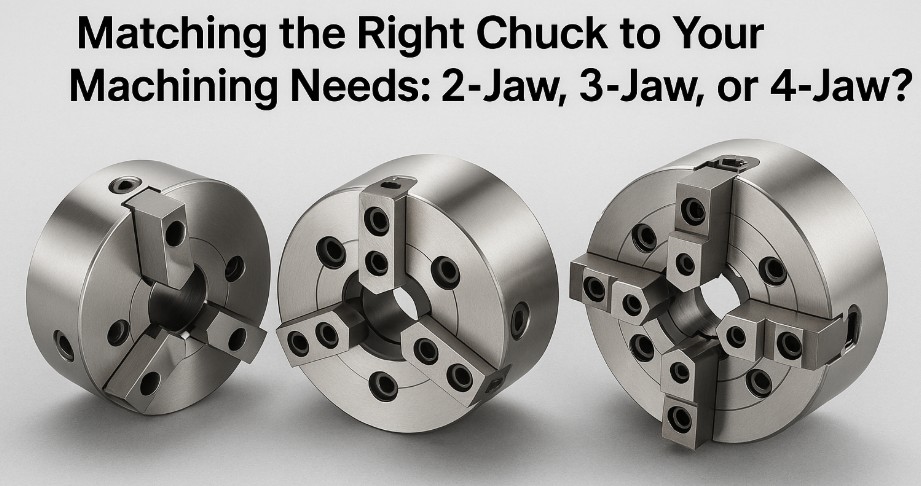
2-Jaw Chucks
Characteristics and Applications
2-jaw chucks are designed with two jaws positioned opposite each other. This configuration is particularly advantageous for gripping irregularly shaped workpieces, such as rectangular, square, or asymmetrical components. The independent movement of each jaw allows for a secure grip on non-circular profiles, making 2-jaw chucks ideal for clamping pipes, tubes, or non-round components (LMJXKJ, 2024).
Advantages
- Adaptability: The ability to adjust each jaw independently makes 2-jaw chucks highly adaptable to irregular shapes, providing excellent clamping force and stability for asymmetric components (LMJXKJ, 2024).
- Ease of Use: Setup and alignment are often quicker compared to chucks with more jaws, especially when working with irregular shapes (LMJXKJ, 2024).
Disadvantages
- Stability: 2-jaw chucks concentrate clamping force on two points, which can be less stable for round parts compared to chucks with more jaws (LMJXKJ, 2024).
3-Jaw Chucks
Characteristics and Applications
3-jaw chucks are among the most common types used in CNC machining. They feature three jaws forming a triangle, which provides self-centering capabilities, making them ideal for holding round or hexagonal workpieces. The jaws move simultaneously, opening or closing to grip the workpiece firmly (Rayco Fixture).
Advantages
- Self-Centering: The self-centering nature of 3-jaw chucks makes them a natural option for fast-paced setting and processing, saving time and effort during machining (Rayco Fixture).
- Versatility: 3-jaw chucks are versatile, capable of holding round, hexagonal, and irregularly shaped workpieces without the need to switch to a different chuck (Rayco Fixture).
- Cost-Effective: Generally, 3-jaw chucks are less expensive than 4-jaw alternatives (Rayco Fixture).
Disadvantages
- Precision: The scroll plate tooth design limits the precision of a 3-jaw chuck compared to a 4-jaw independent alternative (Rayco Fixture).
4-Jaw Chucks
Characteristics and Applications
4-jaw chucks feature four independently adjustable jaws, offering superior clamping stability and versatility. This design is particularly useful for securing irregular shapes or workpieces where each jaw must be positioned separately to achieve the best hold (Jetcrafted).
Advantages
- Individual Jaw Control: Each jaw can be adjusted independently, making 4-jaw chucks suitable for holding irregularly shaped or non-cylindrical workpieces (Gator Lathe Chucks).
- Increased Holding Power: The ability to move each jaw independently allows for precise centering and customization, offering increased holding power (Gator Lathe Chucks).
- Versatility: 4-jaw chucks are perfect for machining square or rectangular stock, eccentric turning, and heavy-duty applications (LMJXKJ, 2024).
Disadvantages
- Setup Time: The independent nature of 4-jaw chucks slows down processing speeds because the operator must stop to center each workpiece (Rayco Fixture).
Conclusion
Choosing the right chuck is a strategic decision that can significantly impact the efficiency and quality of machining operations. Each type of chuck has its strengths and weaknesses, making them suitable for different applications:
- 2-Jaw Chucks: Best for irregularly shaped workpieces and quick setups, but less stable for round parts.
- 3-Jaw Chucks: Ideal for high-volume production of round or hexagonal parts, offering a balance between cost and versatility.
- 4-Jaw Chucks: Provide superior clamping force and versatility for irregular shapes and heavy-duty applications, albeit with longer setup times.
Ultimately, the choice of chuck should be guided by the specific requirements of the machining task, the shape and size of the workpiece, and the desired level of precision and efficiency.
Ultimately, the choice of chuck should be guided by the specific requirements of the machining task, the shape and size of the workpiece, and the desired level of precision and efficiency.
For those seeking high-performance and reliable lathe chucks, AUTOGRIP MACHINERY CO., LTD., a leading Taiwan-based manufacturer, offers a comprehensive range of precision-engineered solutions. Their product lineup includes:
- 2-Jaw Lathe Chuck: Designed for gripping irregular or asymmetrical workpieces with a long-stroke wedge hook type mechanism that ensures stability and adaptability in specialized turning tasks.
- 3-Jaw Lathe Chuck: A crank-type chuck featuring extra-long stroke and through-hole design, ideal for high-volume production involving round or hexagonal parts.
- 4-Jaw Lathe Chuck: With independently adjustable jaws, this model is well-suited for clamping complex or non-cylindrical components in heavy-duty machining applications.
Engineered for durability, precision, and versatility, AUTOGRIP’s lathe chucks are trusted by professionals worldwide to meet the demands of modern machining.