A buckle marked “1 inch” is a sensible starting point for 1-inch webbing. It is not, by itself, proof that the finished strap assembly will fit or perform as intended. Webbing thickness, slot geometry, adjustment method, and the way the two buckle halves engage all matter.
Use the size label to shortlist candidates. Then check the actual webbing, the buckle drawing, and an assembled sample before approving a part for production.
What Does a Side Release Buckle Size Mean?
The stated size generally identifies the nominal webbing width the buckle is intended to accept. It does not describe the buckle’s overall outside width or length.
Metric and inch labels are often rounded naming conventions. They should not be treated as exact conversions:
Inch label
Exact conversion
Common metric label
3/8 in
9.5 mm
10 mm
5/8 in
15.9 mm
16 mm
3/4 in
19.1 mm
20 mm
1 in
25.4 mm
25 mm
1½ in
38.1 mm
38 mm
2 in
50.8 mm
50 or 51 mm
These are common labels, not a promise that every buckle in a row fits every webbing sold under that label. Check the dimensions and intended webbing width of the specific model.
Check the Webbing That Will Be Used in Production
Start with a sample of the actual webbing, rather than relying only on its catalog description. Measure its width at several points and check the thickness of the section that will pass through the buckle. Weave, coating, edge finish, and production tolerances can affect fit.
Also decide what the strap needs to do. Will the webbing be fixed after sewing, or must it move through an adjustment slot? A fit that allows convenient adjustment may not hold the strap in the same way as a fixed assembly. Evaluate the buckle together with the planned threading and stitching method.
Compare the Sample With the Buckle Drawing
Review the manufacturer’s drawing for each webbing slot or channel used in the assembly. Confirm that the webbing can be threaded without binding, excessive folding, or unwanted side-to-side movement. If both buckle halves attach to webbing, check both sides.
The male and female halves also need to engage and release as designed. Use the matched components specified for the model; do not assume that halves from different designs or suppliers are interchangeable because their nominal widths match.
Test a Complete Assembly
For example, a designer using nominal 25 mm webbing might shortlist a buckle labeled 25 mm or 1 inch. The next step is to thread the production-intent webbing through a sample, assemble the strap, and check:
Whether the webbing fits and follows the intended path.
Whether adjustment is smooth, or the fixed strap remains in place as required.
Whether the two buckle halves engage fully and release predictably.
Whether the assembly performs under the load direction and conditions expected in the finished product.
Buckle width alone does not establish a load rating. Where failure could affect safety or essential equipment, define the applicable performance requirements and obtain model-specific test information before approval.
Match the Checks to the Application
An everyday bag may place greater emphasis on comfortable operation and easy strap adjustment. A pet product may require particular attention to the assembled fit, edges, and unintended release. Outdoor equipment may also need evaluation after exposure to the temperatures, moisture, sunlight, and wear expected in use.
These considerations guide testing; they do not assign a particular application to a particular buckle width. Two buckles with the same nominal size can have different shapes, materials, and operating characteristics.
What to Send a Buckle Supplier
A useful request includes the nominal and measured webbing width, webbing thickness and construction, the planned threading or sewing method, the application, expected loading direction, environmental conditions, and any requirements for color or appearance. Ask for the drawing and samples of the proposed model, then verify them in the intended assembly.
For buyers comparing available styles and widths, Shin Fang’s side release buckle range provides a starting point for identifying candidate models. The final choice should be confirmed against the selected model’s specifications and a production-representative strap assembly.
Material selection often becomes difficult when an application needs more than strength alone. A part may need to keep its shape, but it may also need to bend repeatedly, absorb impact, improve grip, feel comfortable on contact, or recover after deformation. In these cases, the decision between engineering plastics and thermoplastic elastomers is not a simple comparison between hard and soft materials. It is a decision about which performance characteristics matter most in real use. When flexibility plays a larger role than rigidity, choosing the wrong material can lead to cracking, poor tactile quality, short service life, or unnecessary redesign.
The Real Difference Between Engineering Plastics and Thermoplastic Elastomers
Engineering plastics are typically chosen for stiffness, dimensional stability, and structural reliability. They are useful when a component must resist deformation, maintain precision, and perform under mechanical or thermal stress. In many applications, they provide the backbone of a design.
Thermoplastic elastomers, by contrast, are selected for elasticity, soft touch, resilience, and impact absorption. They are better suited to applications where repeated bending, cushioning, sealing, or grip matters more than rigid structural support. Their value lies in the ability to flex and recover while still being processed with the efficiency associated with thermoplastics.
The key point is that flexibility should not be treated as a secondary feature. In many end-use conditions, it is the property that determines whether a part continues performing over time.
When Rigidity Creates Problems Instead of Solving Them
A rigid material can look safe during early evaluation because it feels strong and stable. However, rigidity becomes a weakness when a part is exposed to repeated movement, sudden impact, or frequent physical contact.
Several common problems appear when an engineering plastic is used in an application that actually demands flexibility:
stress whitening around bend points
cracking after repeated deflection
discomfort or poor tactile response on touch surfaces
inadequate energy absorption under impact
failure in snap-fit or dynamic movement zones
These failures are not always caused by poor quality. More often, they come from a mismatch between the mechanical behavior of the material and the actual function of the part.
A Practical Comparison of Material Behavior
To make the selection process more useful, it helps to compare how these material families behave under real design priorities rather than abstract material categories.
Before reviewing the table below, one point is worth keeping in mind: stiffness is not always a performance advantage. In some designs, recovery, touch, and impact resistance have greater influence on long-term success.
Design Factor
Engineering Plastics
Thermoplastic Elastomers
Stiffness
High
Low to medium
Elastic recovery
Limited
Strong
Surface feel
Hard and firm
Soft, flexible, grippy
Impact absorption
Moderate
Usually better
Dimensional stability
Excellent
Lower under continuous load
Repeated bending performance
Can be limited
Typically better suited
Structural support
Strong
Limited
Overmolding potential
Possible, depending on system
Often highly suitable
This comparison does not mean one category is superior. It shows that the wrong emphasis in material selection can lead directly to performance problems.
How SEBS, TPU, TPEE, EVA, and POE Fit Different Design Needs
Within thermoplastic elastomers, material choice still requires careful judgment. SEBS, TPU, TPEE, EVA, and POE each solve different problems, and grouping them together without distinction often leads to oversimplified decisions.
SEBS is often selected when softness, comfort, appearance, and grip are major priorities. It works well in applications where touch quality matters and where moderate flexibility is needed without moving into higher-cost performance territory.
TPU is widely used when elasticity must be combined with abrasion resistance and mechanical strength. It is often a stronger candidate for applications exposed to wear, repeated handling, or harsher mechanical stress.
TPEE for dynamic performance and stronger resilience
TPEE is often considered when flexibility alone is not enough. It offers elastic behavior together with better fatigue resistance and stronger mechanical performance, making it useful in parts that experience repeated motion or demanding service conditions.
EVA is commonly chosen for softness, shock absorption, and comfort-oriented performance. It is suitable where cushioning matters more than structural precision.
POE for impact modification and flexible performance
POE is often used when improved flexibility and impact resistance are needed, especially in formulations designed to enhance toughness or low-temperature behavior.
A supplier such as Prochase, with experience spanning compounded plastics, engineering plastics, thermoplastic elastomers, and multiple application environments, reflects the kind of broader material understanding that becomes useful when a project cannot be solved by rigid materials alone.
Failure Modes That Reveal a Poor Material Match
One of the clearest ways to improve selection decisions is to study how wrong choices fail. Material problems usually appear in patterns.
When a rigid material is pushed into a flexibility-driven role, the result may include brittleness, crack propagation, or stress marks. When a soft elastomer is used where structural support is critical, the result may be deformation, poor fit, creep, or loss of dimensional control.
In many cases, the failure does not show up immediately. A part may pass early evaluation and still fail after repeated use, environmental exposure, or extended mechanical stress. That is why the selection process must account for actual motion, contact, temperature, and load conditions rather than relying only on initial feel or isolated data points.
Matching Design Intent to Material Direction
A more reliable method is to begin with the part’s real functional demand. Is the material supposed to hold structure, absorb force, improve handling, or survive repeated flexing?
The following table offers a practical shortcut for early evaluation.
Design Need
Material Direction
Shape retention and structural stability
Engineering plastics
Soft-touch surface and grip
SEBS
Flexible part with abrasion resistance
TPU
Repeated motion with stronger elastic mechanics
TPEE
Cushioning and soft compression
EVA
Improved toughness and flexibility
POE-based solution
Structure combined with flexible outer performance
Engineering plastic with elastomer overmolding
This kind of framework helps narrow material direction before more detailed testing begins.
Material Decisions Improve When Performance Is Viewed as a System
The most effective choice is rarely based on hardness alone. A part succeeds when stiffness, rebound, touch, impact behavior, durability, and processing method are evaluated together. That is especially true in applications where flexibility is central to how the part performs over time.
Engineering plastics remain essential where precision and strength dominate. Thermoplastic elastomers become more valuable when recovery, comfort, movement, and impact resistance shape the real demands of use. The more accurately these priorities are identified at the start, the lower the risk of redesign, failure, or overengineering. In practice, better material selection comes from understanding what the part must continue doing after months of real use—not simply how rigid it feels on day one.
Plastic reduction is no longer a niche sustainability issue. Across global markets, it is changing how food packaging is selected, tested, and positioned. Restrictions on certain single-use items, tighter recyclability expectations, and shifting waste-management rules are forcing packaging decisions to become more precise. What once depended mainly on cost or existing material preference now requires a broader evaluation of compliance, performance, and end-of-life practicality. As a result, food packaging choices are being reshaped not by a simple move away from plastic, but by a more application-specific approach to material selection.
Policy Pressure Is Changing the Basis of Packaging Decisions
Global plastic reduction policies are affecting packaging in different ways. Some markets focus on banning specific single-use plastic items. Others emphasize recyclability, recycled content, labeling requirements, or producer responsibility. Even where regulations are not yet fully restrictive, downstream expectations from distributors, retailers, and end users are already influencing packaging specifications.
This means packaging choices can no longer be based on habit. A format that remains acceptable in one region may create compliance or perception risks in another. For food packaging, this has made market destination an increasingly important factor in material selection. Decisions now have to consider not only what the package does, but also how it will be interpreted within local regulatory and disposal systems.
Why One Material Can No Longer Fit Every Packaging Need
One of the clearest effects of plastic reduction policy is the decline of single-material thinking. In the past, using one material family across multiple product lines could simplify sourcing and standardization. Today, that approach often creates more constraints than efficiency.
Food packaging performs under very different conditions. Hot meals, cold drinks, oily foods, and takeaway items do not place the same demands on containers or cups. A package that looks environmentally preferable on paper may fail if it cannot withstand moisture, grease, heat, sealing pressure, or transportation time. This is why global plastic reduction policies are not just reducing plastic use; they are forcing a closer match between packaging material and real application conditions.
How Paper, PLA, and Recyclable Plastics Are Taking on Different Roles
As packaging choices become more policy-sensitive, material roles are becoming more defined rather than more uniform. Paper, PLA, and recyclable plastics each address different priorities, and their value depends heavily on market context and usage requirements.
The table below shows how these materials are commonly positioned in today’s food packaging landscape.
Material
Primary Strength
Key Limitation
Typical Packaging Role
Paper-based packaging
Widely associated with plastic reduction and strong visual branding potential
May need additional barrier design for moisture- or grease-heavy foods
Cups, takeaway boxes, selected food containers
PLA-based packaging
Supports compostable positioning in suitable systems
Composting infrastructure is inconsistent across regions
May face more scrutiny where plastic reduction messaging is dominant
Hot food containers, microwaveable meal packaging
Recyclable PET
Excellent clarity and presentation for cold items
Limited suitability for high-heat applications
Cold beverages, desserts, salads
This distribution of roles shows that plastic reduction policies are not leading to one universal replacement material. Instead, they are encouraging more selective packaging choices based on how products are consumed, transported, and disposed of.
Compliance, Cost, and Performance Now Have to Be Judged Together
As regulations tighten, packaging changes that look simple at first often become more complex in practice. Replacing a plastic format with a paper or compostable alternative may support compliance goals, but it can also affect durability, sealing consistency, shelf presentation, or cost structure. In other cases, a recyclable plastic may remain the most practical solution for a specific food application, even under growing pressure to reduce plastic use overall.
This is why packaging evaluation now depends on balancing three considerations at the same time:
Compliance, including current restrictions and likely future policy direction
Performance, especially under real conditions such as heat, moisture, oil, and transport
Cost, including not only unit price but also risk of leakage, deformation, or product loss
When one of these factors is ignored, packaging transitions become reactive. When all three are assessed together, material choices tend to be more stable and more defensible across markets.
Reshaping Packaging Choices Requires More Flexible Supply Capability
Because global plastic reduction policies are changing the logic of material selection, packaging suppliers are increasingly expected to support more than a narrow product range. Flexibility now matters as much as availability.Day Young is one example of the type of supplier that aligns with this shift, offering:
custom printing services that support both branding and packaging differentiation
integrated in-house production to improve coordination, consistency, and manufacturing control
Packaging Choices Are Becoming More Context-Driven
Global plastic reduction policies are reshaping food packaging choices by making material selection more conditional, not more simplistic. The key change is not that one material is replacing another everywhere, but that packaging decisions are becoming more dependent on geography, food type, performance requirements, and disposal reality. In this environment, paper, PLA, and recyclable plastics each have a role, but only when used in the right context. The direction of the market is increasingly clear: food packaging is moving away from default material preference and toward better-matched, policy-aware packaging systems.
As the textile industry looks for more responsible ways to manage resources, recycled inputs are becoming part of a broader shift in material development. Among these, T2T (textile-to-textile) recycled cotton is receiving growing attention for its potential to give discarded textiles a new role in fiber production.
AceGreen’s lyocell filament made with T2T recycled cotton reflects this direction. Rather than presenting recycled materials only as a sustainability concept, it points to a practical effort to connect textile waste recovery with new fiber applications.
Why Textile-to-Textile Recycling Matters
One of the biggest challenges in textiles is that large amounts of post-use material still end up as waste. This is especially true for blended fabrics, which are often more difficult to separate and recover.
Textile-to-textile recycling matters because it helps shift the industry away from a linear model and toward one that keeps materials in use for longer.
Key reasons this matters include:
reducing the amount of textile waste sent to landfill or incineration
recovering value from discarded cotton-based materials
supporting more efficient use of existing resources
creating new possibilities for next-generation fiber development
A Closer Look at T2T Recycled Cotton in Lyocell Filament
The use of T2T recycled cotton in lyocell filament highlights an important change in how fiber innovation is being approached. The discussion is no longer only about how a fiber performs, but also about where its raw materials come from and how they are processed.
In this context, recycled cotton offers a meaningful point of focus. It suggests a pathway in which waste materials can be reintroduced into the textile cycle instead of being treated as an end-of-life output.
This development also reflects several broader industry shifts:
stronger interest in circular material systems
greater attention to raw material traceability
ongoing efforts to reduce dependence on virgin inputs
increased focus on the environmental impact of fiber sourcing
Environmental Commitment in Practice
AceGreen’s focus on lyocell filament made with T2T recycled cotton is part of a wider commitment to environmentally conscious material development. The value of this kind of work is not only in the final material itself, but also in what it represents for future textile production.
It highlights an approach centered on:
material innovation linked to waste reduction
collaboration across recycling and fiber development
practical exploration of circular textile solutions
continued investment in more responsible production pathways
Rather than positioning sustainability as a separate message, this direction shows how environmental considerations can be built into material planning and development.
Why This Development Is Worth Watching
As expectations around resource use continue to change, materials made with recycled inputs are likely to play a more important role in the textile industry. What makes this area worth watching is not only the concept of recycling itself, but the ability to turn that concept into workable material solutions.
Lyocell filament made with T2T recycled cotton draws attention because it connects several important ideas at once:
textile waste can be viewed as a resource, not only as disposal
recycled cotton can contribute to new manmade cellulosic fiber pathways
circularity becomes more meaningful when it is tied to actual material development
environmental progress depends on both innovation and application
Looking Ahead
The shift toward circular textiles will depend on more than broad goals. It will require continued work in material innovation, recovery systems, and practical implementation.
AceGreen’s lyocell filament made with T2T recycled cotton reflects one part of that ongoing transition. It shows how recycled feedstocks can support new thinking in fiber development, while also contributing to a larger industry conversation about waste, resources, and the future of textile materials.
Climate change is forcing growers to rethink crop protection at a structural level. What used to be manageable seasonal variation has become a more complex pattern of heat stress, stronger winds, sudden hail events, and shifting insect pressure. For farms operating in open fields, this means that conventional protection methods are no longer enough on their own. Crop protection is no longer just about responding to damage after it appears. It is increasingly about designing growing environments that can withstand more volatile conditions while protecting yield consistency, crop quality, and input efficiency.
Why Traditional Open-Field Protection Is Becoming Less Reliable
For decades, many growers built protection strategies around local weather patterns, historical pest cycles, and field experience. That model worked when seasonal conditions were relatively stable and risks were easier to anticipate. Today, climate volatility is weakening the reliability of those assumptions.
Open-field crops are now more likely to face multiple stresses within the same production cycle. A period of excessive heat may be followed by wind damage, erratic rainfall, or a surge in pest activity. These events do not affect crops separately. They compound one another, weakening plant health, increasing management difficulty, and making field performance less predictable.
This is why crop protection strategies are changing. Growers are no longer choosing protection tools only for isolated threats. They are increasingly looking for systems that can reduce environmental stress across the entire crop cycle.
The New Weather Risks Growers Face More Often
Climate change does not create just one new problem. It changes the frequency, intensity, and timing of several risks that directly affect crop performance.
Heat Stress and Excessive Sunlight
Higher temperatures and stronger solar exposure can disrupt plant development, increase transpiration, and reduce crop quality. In sensitive crops, prolonged heat stress can lead to leaf damage, uneven growth, and lower marketable output. It can also narrow the margin for error in irrigation and nutrient management.
Stronger Winds and Storm Exposure
Wind can damage crops mechanically and physiologically. It can break stems, injure foliage, interfere with flowering, and accelerate moisture loss. In orchards, nurseries, and exposed field sites, stronger wind events can also reduce uniformity across planting areas and raise the risk of long-term production instability.
Hail Events and Sudden Crop Damage
Hail remains one of the most destructive acute weather events because the damage is immediate. A short storm can scar fruit, tear leaves, and sharply reduce saleable quality. For higher-value crops, even limited physical damage can translate into major commercial losses.
Rising Insect Pressure in Changing Climates
As temperatures rise and seasons shift, pest activity may last longer and spread into periods that were once lower risk. This makes pest management harder to time and more expensive to control. It also increases the value of preventive physical barriers, especially where repeated chemical intervention becomes less efficient or less desirable.
These changes are pushing growers to think beyond seasonal habits and toward more targeted risk management. The table below shows how these climate-related pressures are changing protection priorities in modern agriculture.
How Agrotextiles Help Build More Stable Growing Conditions
One of the most important shifts in modern crop protection is the move from reactive control to physical risk reduction. Agrotextiles play a central role in this shift because they help growers modify field conditions before environmental pressure causes significant crop loss.
Shade nets are increasingly important in regions facing stronger sunlight and more frequent heat stress. By moderating light intensity and reducing excessive heat load, they help protect plant tissue and create more suitable growing conditions. The right shading level depends on crop type, climate, and season, which is why net selection should be linked to agronomic needs rather than general preference.
Windbreak nets help reduce wind speed and create a more protected production environment. This is especially useful in orchards, nurseries, and open-field operations where wind exposure affects both crop health and field uniformity. Beyond preventing visible damage, wind reduction can improve crop stability over time by reducing repeated stress.
Insect nets provide a non-chemical layer of defense against pests such as aphids, thrips, and whiteflies. As climate conditions make pest pressure more difficult to predict, physical exclusion becomes more valuable as a long-term strategy. It supports earlier intervention, lowers exposure to infestation risk, and helps reduce overdependence on reactive spraying.
Ground Cover for Moisture Retention and Weed Suppression
Ground cover supports crop protection from the soil upward. It helps suppress weeds, retain moisture, and protect soil structure, all of which become more important under hotter and drier conditions. For growers dealing with water stress and field efficiency challenges, ground cover can contribute to better root-zone stability and more consistent growing performance.
Choosing Protection Systems Based on Climate Risk, Not Habit
One of the biggest strategic mistakes in modern agriculture is continuing to choose protection systems based mainly on routine. A net type, material, or installation method that worked well in the past may no longer match current field conditions.
A stronger approach is to assess protection needs through climate exposure. Growers should begin by identifying which risks create the most repeated loss, at which crop stages those risks do the most damage, and which protection tools can reduce that pressure early. In many cases, the most effective strategy is not a single product but a combination of tools that address light, wind, insects, and soil conditions together.
As a long-established Taiwan-based manufacturer founded in 1967, Hsia Cheng offers strengths that fit this more adaptive approach to agriculture:
A three-generation family-owned background with long-term manufacturing experience
A broad portfolio including anti-insect nets, ground covers, woven shade nets, knitted shade nets, windbreak nets, anti-hail nets, olive nets, and geogrid
A focus on helping customers match products to different environmental conditions
Product characteristics that emphasize UV resistance, durability, crop protection, and growth support
Customizable and made-to-measure solutions for different agricultural applications
Building A More Resilient Crop Protection Plan For The Next Decade
Climate change is reshaping crop protection by changing what growers need protection systems to do. It is no longer enough to prepare only for familiar seasonal threats. Modern protection strategies must help crops perform under more variable heat, wind, pest, and moisture conditions. This requires a more integrated and preventive mindset—one that treats crop protection as part of production stability, not only damage control. Growers who adapt early will be better positioned to protect crop quality, reduce avoidable loss, and build more resilient operations in the years ahead.
In CNC machining, coolant is often treated as a routine consumable—something to replace when it degrades and dispose of when it can no longer perform effectively. But in many machine shops, coolant condition has a much broader impact, affecting tool life, machining consistency, disposal costs, and even shop-floor hygiene.
As manufacturers place greater emphasis on operational efficiency and sustainability, coolant management is drawing more attention as an area with measurable upside. In some cases, better purification and maintenance practices can help shops achieve 40% less coolant disposal, making the benefits easier to understand in both financial and environmental terms.
Why Coolant Quality Matters More Than Many Shops Realize
In real-world machining environments, coolant is constantly exposed to tramp oil, metal fines, and bacterial growth. Over time, this contamination reduces its cooling and lubricating performance. The result is often a chain reaction: unpleasant odors, more frequent fluid replacement, shorter tool life, and rising waste disposal costs.
Poor coolant quality can also affect machining stability. When fluid performance becomes inconsistent, shops may face greater difficulty maintaining precision, especially in processes where heat control and lubrication play a critical role.
A Growing Issue for Cost Control and Sustainability
For manufacturers trying to control operating costs while meeting ESG or environmental goals, coolant waste is no longer a minor maintenance issue. Every unnecessary coolant change means more fluid purchasing, more waste handling, and more resources spent on disposal.
That is why measurable outcomes matter. When a shop is able to reduce waste coolant volume significantly—sometimes by as much as 40% less coolant disposal through improved purification—it turns coolant management from a maintenance task into a practical business lever. A reduction at that level gives production teams something concrete: less waste to process, fewer disposal cycles, and a clearer path toward cleaner operations.
What Shops Typically Need from a Purification System
To improve coolant life in a meaningful way, manufacturers usually need a solution that addresses the root causes of fluid degradation rather than just the visible symptoms.
That often includes:
removing tramp oil and suspended particles
controlling bacterial growth and odor
maintaining coolant condition during production
minimizing consumables and maintenance burden
Solutions that can do this continuously, without forcing frequent machine stoppages, are especially relevant for busy CNC operations.
How HC FENG Is Addressing Coolant Waste
One company active in this area is HC FENG, which focuses on coolant purification and fluid management solutions for machining applications. According to its published information, the company’s BEST-1 Coolant Oil Skimmer is designed to remove tramp oil and micro-particles, reduce bacterial growth through ozone sterilization, and operate without filter consumables.
This combination is notable because it connects waste reduction with day-to-day production needs. Instead of treating coolant disposal as an unavoidable cost, the approach suggests that better fluid maintenance can support longer coolant life, improved machine performance, and lower waste output at the same time.
The broader significance of coolant purification is that it can influence several performance indicators at once. A shop that improves coolant condition may benefit from:
lower coolant disposal and replacement frequency
improved machining consistency
longer tool life
cleaner working conditions
stronger alignment with sustainability targets
This is why the topic is becoming more relevant in modern manufacturing. A result such as achieving 40% less coolant disposal is not only about waste reduction—it also signals that the entire coolant management process may be operating more efficiently.
The Operational Value of Better Coolant Control
For CNC shops aiming to improve efficiency while reducing waste, coolant management is becoming increasingly difficult to overlook. What has long been treated as a routine maintenance issue can influence a much wider range of outcomes, from fluid disposal volume and operating costs to machining stability and workplace conditions. As manufacturers continue to balance productivity with sustainability goals, better coolant control stands out as one of the more practical ways to support both. In that context, reducing coolant waste is not simply a maintenance improvement, but part of building a cleaner, more efficient, and more resilient machining operation.
Choosing the right paper cup is more important than many buyers first assume. For coffee shops, beverage brands, importers, distributors, and foodservice operators, the wrong cup can lead to customer complaints, poor handling comfort, inconsistent branding, and higher operating costs. A cup is not just a container—it affects temperature retention, user experience, product safety, and brand perception.
That is why understanding the differences between single wall, double wall, and ripple wall cups is essential. If you are comparing suppliers, planning a custom paper cup order, or searching for a reliable paper cup manufacturer, this guide will help you choose the right cup type based on real usage scenarios rather than assumptions.
Many buyers focus on cup size, printing, or price first. However, cup structure is often the factor that most directly affects performance. The wall construction of a paper cup influences:
Heat insulation
Grip comfort
Cup rigidity
Material usage
Printing surface
End-user perception
Suitability for lids and takeaway service
For hot drinks especially, choosing the wrong wall type may result in a cup that feels too hot to hold, requires an extra sleeve, or creates a lower-quality impression. For branded beverage businesses, the cup structure also affects how the final printed product looks and feels in customers’ hands.
What Is a Single Wall Paper Cup?
A single wall paper cup is the most basic and widely used option. It is made with one layer of paperboard and is commonly used for hot or cold beverages, depending on its coating and design.
Single wall cups are often chosen because they are cost-effective, lightweight, and easy to store. They are suitable for lower-temperature drinks, shorter holding times, or situations where an additional sleeve is acceptable.
Best use cases for single wall cups
Tea shops
Water, juice, and cold beverages
Office events
Sampling stations
Basic takeaway coffee with sleeve support
Main advantages
Lower unit cost
Wide size availability
Easy for large-volume ordering
Good option for standard branded printing
Main limitations
Limited insulation for hot drinks
May require an additional sleeve
Lower premium feel compared with thicker cup types
For businesses focused mainly on cost control, a single wall cup can still be a practical choice. But for hot beverage programs, comfort and brand experience may become concerns.
What Is a Double Wall Paper Cup?
A double wall paper cup includes two layers of paperboard. The added outer layer creates better insulation and improves the feel of the cup in hand. Compared with a single wall cup, it is more comfortable for customers holding hot beverages and often eliminates the need for a separate sleeve.
Double wall cups are widely used by coffee brands, bakeries, and takeaway beverage operators that want a cleaner presentation and stronger cup body. The outer wall can also improve the visual impression of a custom paper cup, especially for brands that want a more premium look.
Best use cases for double wall cups
Coffee shops
Premium tea brands
Hotels and catering
Branded takeaway beverages
Medium to high-temperature drinks
Main advantages
Better heat insulation
More comfortable to hold
No separate sleeve needed in many cases
Stronger and more premium appearance
Main limitations
Higher material cost than single wall cups
Slightly more bulk in storage and shipping
May not offer the textured grip some users prefer
Double wall cups are often the middle ground between cost and customer experience. For many beverage brands, they offer a strong balance of functionality and presentation.
What Is a Ripple Wall Paper Cup?
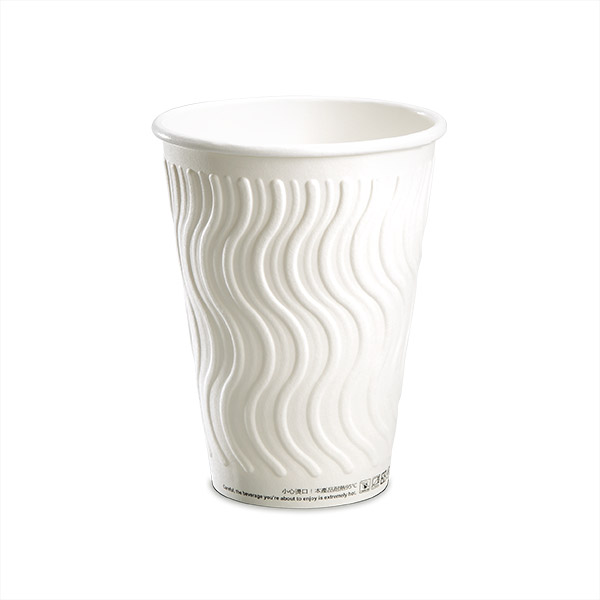
Ripple wall cups use an outer corrugated or textured paper layer that creates air pockets between layers. This design improves insulation and provides an anti-slip grip. Among the three common types, ripple wall cups are often the most recognizable in premium hot drink service.
Many buyers choose ripple wall cups for specialty coffee, premium takeaway service, and customer-facing businesses where comfort matters. The textured exterior gives the cup a distinct feel and can help signal product quality.
Best use cases for ripple wall cups
Specialty coffee shops
Premium takeaway programs
High-temperature beverages
Fast-service environments
Brands focused on customer experience
Main advantages
Excellent insulation
Comfortable grip
Textured surface reduces slipping
Strong premium perception
Main limitations
Usually higher cost
Exterior printing options may be more limited depending on design
Not always necessary for lower-temperature drinks
Ripple wall cups are especially useful when a business wants to combine function and perceived quality. However, not every operation needs the highest insulation level.
Quick Comparison Table
Before making a sourcing decision, it helps to compare the three structures side by side. The table below gives a simplified view for buyers evaluating different options.
Cup Type
Insulation
Comfort for Hot Drinks
Cost Level
Brand Presentation
Typical Use
Single Wall
Basic
Low to moderate
Low
Standard
Cold drinks, light hot drink use
Double Wall
Good
Good
Medium
Premium and clean
Coffee, tea, takeaway beverages
Ripple Wall
Very good
Very good
Medium to high
Premium and textured
Specialty coffee, hot drinks
This comparison is helpful as a starting point, but the right choice still depends on your menu, customer expectations, and packaging budget.
How to Choose the Right Paper Cup Type
Consider beverage temperature
If you mainly serve iced drinks, a single wall cup may be enough. If you serve hot coffee, milk tea, or other high-temperature drinks, double wall or ripple wall cups are often more suitable.
Think about customer handling time
A customer who drinks quickly in-store has different needs from someone carrying a takeaway cup for 20 minutes. Longer holding time usually means higher insulation needs.
Evaluate branding goals
If packaging is part of your marketing, the cup is more than functional. A well-designed custom paper cup can improve brand recall and elevate perceived quality. In these cases, cup structure should support both comfort and appearance.
Review total packaging cost
Do not compare only cup price. A lower-priced single wall cup may need an added sleeve, increasing total cost and handling complexity. Buyers should compare the full packaging system, not just one component.
Work with an experienced paper cup manufacturer
The best suppliers do more than sell sizes—they help buyers match cup structure to actual use. A knowledgeable paper cup manufacturer can recommend the right option based on beverage type, volume, branding needs, and distribution model.
Common Buyer Mistakes
Many buyers assume the thickest cup is always the best option. In reality, over-specifying can increase cost without creating meaningful customer value. Others focus only on appearance and overlook how the cup performs in real use. Another common mistake is ordering a custom paper cup design before confirming the most suitable structure, which can create rework, delays, or poor customer feedback.
The smartest approach is to define the use case first, then confirm the cup type, then move into printing and branding.
Choosing the Right Cup for Your Business
There is no single best paper cup type for every business. A single wall cup may be ideal for cost-sensitive operations and cold beverages, while a double wall cup offers a better balance of insulation, comfort, and brand presentation for many hot drink applications. Ripple wall cups, meanwhile, are often the strongest option when customer grip, heat protection, and premium perception matter most.
The key is to match the cup structure to your actual product, service model, and customer expectations. Instead of choosing based only on price or appearance, buyers should evaluate temperature needs, holding time, branding goals, and total packaging cost. By taking a more practical approach, businesses can select the right paper cup format with greater confidence and avoid common sourcing mistakes that affect both customer satisfaction and operating efficiency.
In the rapidly evolving world of polymer processing and plastic manufacturing, the demand for high-quality, consistent, and cost-effective production has never been higher. For procurement managers, factory owners, and process engineers, the choice of machinery isn’t just a technical decision—it’s a strategic one that determines the future competitiveness of the business.
The co-rotating twin-screw extruder stands as the workhorse of the modern compounding industry. Unlike its single-screw predecessors or counter-rotating counterparts, the co-rotating system offers unparalleled mixing capabilities, modular flexibility, and high throughput. However, mastering this technology requires more than just turning a dial; it requires a deep understanding of its principles and optimization techniques.
This guide serves as a comprehensive resource for industry professionals seeking to bridge the gap between technical theory and profitable production.
1. Addressing the Industry’s Core Pain Points
Before diving into the technicalities, it is essential to acknowledge the common frustrations faced by plastic compounding facilities today:
Inconsistent Product Quality: Variations in color dispersion or mechanical properties lead to high reject rates.
High Energy Consumption: Rising electricity costs are eating into profit margins.
Maintenance Downtime: Excessive wear and tear on screws and barrels stop production lines for days.
Material Versatility Issues: The struggle to switch between different resins (e.g., PP, PE, bio-plastics) without long changeover times.
By understanding the principles of co-rotating twin-screw extrusion, these pain points can be transformed into competitive advantages.
2. Fundamental Principles: Why Co-Rotating?
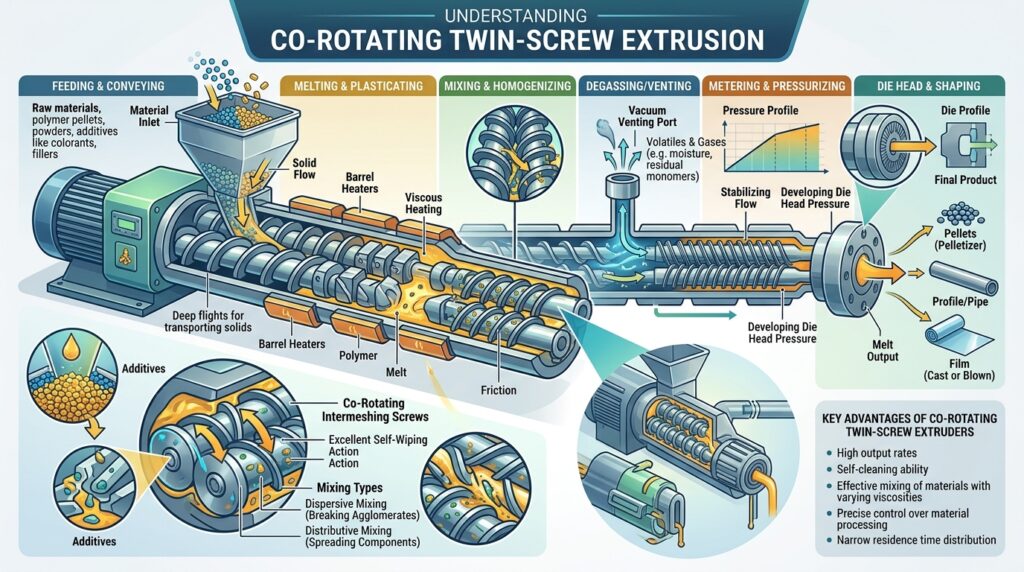
The co-rotating twin-screw extruder features two screws rotating in the same direction within a figure-eight shaped barrel. This configuration is widely preferred for compounding for several key reasons.
The Self-Wiping Effect
One of the most significant advantages of co-rotating screws is the self-wiping action. Because the screws rotate in the same direction, the flight of one screw cleans the channel of the other. This prevents material stagnation, reduces carbonization (degradation), and ensures a narrow Residence Time Distribution (RTD).
Modular Design and Flexibility
Modern extruders utilize a modular design. The screws are not solid pieces but are composed of various elements (conveying, kneading, and mixing blocks) slid onto a splined shaft. This allows engineers to “tune” the screw configuration to the specific needs of the material being processed.
Comparison: Single-Screw vs. Twin-Screw Extrusion
To help procurement teams justify the investment, the following table illustrates the performance differences between these two technologies:
Feature
Single-Screw Extruder
Co-Rotating Twin-Screw Extruder
Mixing Capability
Poor (mainly distributive)
Excellent (distributive and dispersive)
Feeding
Pressure-dependent
Typically flood-fed or starved-fed
Degassing/Venting
Limited
Exceptional (multi-stage venting)
Material Versatility
Low
High (compounding, alloys, recycling)
Self-Wiping
No
Yes
Capital Investment
Lower
Higher
Table 1: Comparison of processing capabilities between single and twin-screw systems. While the initial cost of twin-screw systems is higher, the ROI is often faster due to efficiency and product quality.
3. Key Components and Their Roles in Optimization
Optimization begins with understanding the anatomy of the machine. Each component plays a vital role in the final output.
The Screw Configuration
The screw profile is the “brain” of the extrusion process. It is generally divided into three zones:
Feeding and Conveying Zone: Moves raw pellets or powders from the hopper into the barrel.
Melting and Plasticizing Zone: Uses kneading blocks to generate friction and shear, melting the polymer.
Mixing and Homogenizing Zone: Ensures additives, fillers (like glass fiber or calcium carbonate), and pigments are evenly distributed.
The Barrel and Temperature Control
The barrel is often divided into several zones, each with its own heating and cooling system. Precision in temperature control is critical to preventing thermal degradation of sensitive polymers while ensuring enough heat is present for a stable melt.
The Drive System and Torque
High-torque gearboxes are the heart of the machine. Higher torque allows for higher screw speeds and higher filling degrees, which directly correlates to increased throughput without sacrificing quality.
4. Advanced Applications in Modern Manufacturing
The versatility of the co-rotating twin-screw extruder allows it to dominate several high-value sectors:
Polymer Compounding and Alloying
Creating “alloys” (blending two or more polymers) requires intense mixing to ensure the different phases are properly dispersed. Twin-screw systems are the only viable option for high-performance automotive and electronic grade plastics.
Masterbatch Production
Whether it’s color masterbatch or functional additives (UV stabilizers, flame retardants), the dispersive mixing capability ensures that pigments are broken down to their primary particle size, preventing streaks in the final molded product.
Plastic Recycling and Upcycling
With the global push toward a circular economy, twin-screw extruders are being used to process post-consumer waste. They are particularly effective at removing volatiles and odors through vacuum degassing and incorporating reinforcing fillers to “upcycle” low-grade waste into high-value pellets.
5. Strategic Optimization: Boosting Throughput and Quality
To achieve the best results, operators and owners must focus on Process Optimization.
Specific Mechanical Energy (SME)
SME is a crucial metric. It represents the amount of energy (work) put into the material per unit of mass.
Too high SME: May degrade the polymer chains.
Too low SME: May result in poor mixing or unmelted particles.
Feeding Strategies
Most co-rotating systems use starve-feeding. By decoupling the screw speed from the feed rate, operators gain an extra degree of freedom to control the shear and residence time, allowing for more precise processing.
Troubleshooting Common Issues
Below is a quick-reference guide for troubleshooting common production hurdles:
Symptom
Potential Cause
Suggested Optimization
Surging Output
Inconsistent feeding or low melt pressure
Check feeder calibration; increase screw speed or add a melt pump.
Black Specks/Degradation
Dead spots in the screw or excessive heat
Inspect screw elements for wear; reduce barrel temperature in the last zones.
Poor Dispersion
Insufficient shear or wrong screw design
Add more kneading blocks or increase the RPM.
Excessive Screw Wear
Abrasive fillers (e.g., high glass fiber)
Use hardened, wear-resistant coatings for screws and barrels.
Table 2: Common extrusion problems and their corresponding solutions. Regular monitoring of these parameters can significantly reduce downtime.
6. Industry Spotlight: Choosing the Right Partner (Matila Industrial)
In the search for high-performance machinery, the manufacturer’s engineering philosophy is as important as the machine’s specs. When looking at global leaders in this space, Matila Industrial has established itself as a pivotal player for companies seeking a balance between precision engineering and long-term durability.
Why Matila’s Twin-Screw Solutions Stand Out
Matila’s series of Twin-Screw Co-Rotary Extrusion Machines are designed with the “User-First” principle. Based on industry observations, their machines address several of the aforementioned pain points through specific innovations:
High-Torque Gearbox Engineering: Their drive systems are engineered for stability, allowing for high-capacity output while maintaining low noise levels and high energy efficiency.
Precision Modular Components: Matila offers highly customizable screw configurations and barrel lengths (L/D ratios), ensuring that whether you are processing bio-plastics or high-fill compounds, the machine is perfectly tuned to the material.
Intuitive Control Systems: For procurement managers worried about the “skill gap” in the workforce, Matila integrates user-friendly PLC interfaces that make monitoring SME and temperature profiles straightforward.
By focusing on the synergy between the screw geometry and the drive system, companies like Matila help manufacturers minimize the “Total Cost of Ownership” (TCO)—a metric far more important than the initial purchase price.
7. Procurement Guide: What to Look for in a Twin-Screw Extruder
If you are currently in the market for a new line, consider these four pillars:
Material Compatibility: Does the manufacturer offer specialized alloys for screws (e.g., HIP-PM) if you are running corrosive or abrasive materials?
Scalability: Can the pilot-scale results be easily translated to production-scale machines?
Local Technical Support: Extrusion is a complex process. Having access to fast spare parts and technical expertise is non-negotiable for minimizing downtime.
Energy Efficiency: Look for machines with high-efficiency motors (IE3/IE4) and optimized barrel insulation.
8. FAQ: Answering Your Critical Questions
Q1: What is the difference between co-rotating and counter-rotating twin-screw extruders?
Co-rotating: Screws turn in the same direction. Best for mixing, compounding, and high-speed production. It has a high self-wiping capability.
Counter-rotating: Screws turn in opposite directions. Best for processing PVC or materials that require high pressure and low shear.
Q2: How often should I replace the screw elements?
This depends entirely on the abrasiveness of your material. For standard PP/PE, screws can last years. For materials with 30%+ glass fiber, you should inspect for wear every 6 months. A loss of 10% in throughput usually indicates it’s time for a replacement.
Q3: Can a twin-screw extruder handle 100% recycled plastic?
Yes. In fact, they are superior to single-screw extruders for recycling because they can handle “mixed” fractions and use multi-stage vacuum degassing to remove impurities and odors effectively.
Q4: Is it better to have a longer barrel (High L/D ratio)?
Not necessarily. A higher L/D ratio (e.g., 44:1 or 48:1) provides more space for multiple feeding and venting ports, which is great for complex compounding. However, for simple masterbatches, a 32:1 or 36:1 ratio might be more energy-efficient and cost-effective.
Q5: How can I reduce energy consumption in my extrusion line?
Ensure your heaters are well-insulated, use AC frequency-controlled motors, and optimize your screw design to rely more on mechanical shear for melting rather than external electrical heating.
9. Conclusion: The Path to Extrusion Excellence
The co-rotating twin-screw extruder is more than just a piece of equipment; it is the heart of a profitable plastic manufacturing operation. By focusing on the principles of modularity, self-wiping efficiency, and strategic optimization, businesses can overcome the hurdles of quality inconsistency and high operational costs.
As the industry moves toward more complex materials and more stringent environmental regulations, partnering with an experienced manufacturer becomes a critical success factor. Companies that invest in high-quality machinery—such as the robust and efficient systems provided by Matila Industrial—position themselves to lead the market in both innovation and sustainability.
In the end, the goal is simple: maximum quality at the lowest possible cost per kilogram. With the right knowledge and the right tools, that goal is well within reach.
A deep dive into the matcha drink phenomenon, plus a commercial-grade recipe that’s taking cafés by storm
The Numbers Don’t Lie: Matcha Is Having Its Moment
If you’ve scrolled through Instagram or TikTok lately, you’ve probably noticed an unmistakable trend: vibrant green drinks everywhere. The global matcha market grew from $3.84 billion in 2024 to $4.24 billion in 2025, with an annual growth rate of 10.3 percent, and industry analysts project this momentum to continue well into 2026.
Black Sheep Coffee reported a 227% year-on-year surge in iced beverage sales following the launch of its matcha line, with matcha-based beverages outpacing espresso at some locations Coffee Intelligence. Major chains including Starbucks, Dunkin’, and Peet’s Coffee have all expanded their matcha offerings, signaling a fundamental shift in consumer preferences that shows no signs of slowing.
What’s Fueling the Matcha Boom?
Gen Z’s Search for “Clean Energy”
Gen Z consumers are driving demand for health-forward, photogenic drinks, with matcha emerging as the poster child for this movement Coffee Intelligence. Unlike coffee’s jittery spike and crash, matcha offers sustained energy through its unique combination of caffeine and L-theanine—delivering approximately 70mg of caffeine per serving compared to coffee’s 120mg, but with longer-lasting effects.
The Instagram Effect
Let’s be honest: matcha’s vivid green color is social media gold. The visual appeal of high-quality matcha makes it a natural star in photos and videos Fresh Cup, and this aesthetic quality has become a powerful marketing tool for cafés looking to attract younger demographics.
Wellness Culture Meets Tradition
In the wake of modern stressors and a global pandemic, personal wellness has become a top priority, and matcha fits seamlessly into that lifestyle shift Coffee Intelligence. Consumers appreciate that they’re drinking something with a 2,000-year tradition while meeting their modern health needs.
The Supply Chain Challenge
Here’s the catch: Japanese matcha production hit capacity in 2025, with environmental factors causing a 20 to 30 percent drop in yield, and some producers refusing new customers Global Coffee Report. For café owners and distributors entering 2026, this creates both a challenge and an opportunity.
The solution? Working with reliable B2B suppliers who can provide consistent, quality matcha products at scale.
Recipe Spotlight: Commercial-Grade Matcha Drink
For foodservice operators looking to add matcha to their menu, here’s a professional recipe that balances traditional preparation with commercial efficiency:
Mix the matcha drink powder with hot water, stirring until fully dissolved
Layer ingredients in serving glass: red beans first, followed by ice cubes, matcha liquid, then fresh milk
Top with whipped cream, dust with matcha powder, and garnish with dried cranberries
Pro Tips:
The layered presentation creates that Instagram-worthy aesthetic Gen Z customers love
Red beans add traditional Japanese authenticity, while boba pearls offer a trendy bubble tea crossover
This recipe scales easily for high-volume operations
The B2B Advantage: Customization Is Key
For larger operations—whether you’re running a café chain, managing a food service distribution network, or developing a private label beverage line—the ability to customize your matcha products is crucial.
Companies like Allwin Food, a Taiwan-based B2B beverage powder manufacturer, have positioned themselves to meet this exact need. With FSSC 22000 and HACCP certifications, they offer customization services that go beyond just the powder itself:
For distributors serving multiple markets, this flexibility means you can offer region-specific products without managing multiple suppliers.
Market Outlook: Where Matcha Goes in 2026
Wholesale matcha sales jumped 100% in 2025, while consumer sales were up 15% compared to 2024 Fresh Cup. As we move through 2026, industry experts predict continued growth, driven by:
Product Innovation: Sparkling matcha, nitro matcha, and functional blends combining matcha with adaptogens
Ready-to-Drink Formats: Canned and bottled matcha beverages for grab-and-go convenience
Expanded Applications: Matcha moving beyond beverages into bakery, desserts, and even savory applications
The Bottom Line for Foodservice Operators
Matcha isn’t just another trend—it’s a category transformation. Brands are embedding matcha into their regular menu cycles not as gimmicks, but as repeatable, customizable fixtures.
For businesses looking to capitalize on this moment in 2026, the strategy is clear:
✅ Start Now: Supply constraints mean early adopters have an advantage ✅ Choose Reliable Partners: Work with certified B2B suppliers who can scale with your growth ✅ Customize Strategically: Don’t just add matcha—create signature drinks that differentiate your brand ✅ Plan for Volume: Matcha demand isn’t slowing down; invest in suppliers who can handle increased orders
Whether you’re adding matcha to an existing café menu, launching a new beverage line, or supplying foodservice distributors across multiple regions, the opportunity is significant—but so is the need for strategic planning and reliable partnerships.
About Commercial Matcha Solutions
For foodservice operators, distributors, and private label developers interested in exploring custom matcha formulations, bulk ordering, or white-label solutions, established B2B manufacturers offer comprehensive support including R&D, quality control, and flexible packaging options. Learn more about commercial matcha powder solutions at professional food ingredient suppliers specializing in tea and beverage powder systems.
Sources:
Coffee Intelligence, “Iced matcha beverages take the lead in coffee shops & supermarkets” (2025)
The global beverage market is entering a new phase of supply-chain restructuring. Over the past several years, disruptions in agriculture, transportation, and ingredient sourcing have forced many beverage brands to rethink how they select manufacturing partners. What once appeared to be a straightforward procurement task—finding a reliable fruit juice manufacturer—has become a more strategic decision that directly influences product quality, cost stability, and brand competitiveness.
For procurement managers and product development teams, the challenge is not simply locating a supplier capable of delivering juice ingredients. The real objective is identifying a partner that can support consistent production, accommodate formulation changes, and adapt to evolving consumer trends.
As functional beverages, plant-based drinks, and clean-label products continue gaining traction worldwide, the ability to source high-quality fruit and vegetable juices has become an important competitive advantage.
Why Supplier Selection Matters More in 2026
Several global trends have reshaped the way beverage companies approach ingredient sourcing.
First, agricultural volatility has become more visible. Climate variation, crop diseases, and regional supply disruptions can significantly affect fruit harvest volumes. Suppliers that maintain diversified sourcing networks are therefore better positioned to provide stable production inputs.
Second, consumer expectations have shifted toward transparency and natural ingredients. Beverage brands are increasingly required to demonstrate traceability and quality control across their supply chains. This puts additional pressure on manufacturers to document sourcing practices and processing standards.
Third, the beverage category itself is evolving. Traditional fruit juice products are now joined by functional blends, vegetable-based beverages, and hybrid formulations combining fruit, vegetables, and botanical ingredients. These developments require manufacturers with broader technical capabilities than simple juice processing.
In this environment, the choice of manufacturing partner has implications beyond price or logistics—it directly affects a brand’s ability to innovate and scale.
Understanding the Role of a Modern Fruit Juice Manufacturer
A contemporary fruit juice manufacturer typically performs several functions within the beverage supply chain. Beyond producing juice products, many manufacturers now support formulation development, ingredient customization, and export logistics.
Raw Material Sourcing and Processing Capabilities
The quality of juice products begins with raw fruit and vegetable sourcing. Reliable manufacturers maintain established procurement networks that ensure consistent raw material supply and processing standards.
Processing methods may include juice extraction, concentration, pasteurization, and blending. Each step must be carefully managed to preserve flavor, color, and nutritional characteristics.
Product Formats: Concentrates, Purees, and Blends
Depending on application requirements, manufacturers may provide multiple product formats, including:
Not-from-concentrate (NFC) juices
Bulk fruit juice concentrate for beverage manufacturing
Fruit purees for smoothies and dessert products
Mixed fruit and vegetable juice blends
These options allow beverage brands to optimize transportation efficiency, storage stability, and formulation flexibility.
Customization for Beverage Brands
Customization is becoming an increasingly important capability. Beverage companies frequently require specific flavor profiles, sweetness levels, or ingredient combinations tailored to their brand positioning.
Manufacturers that support private-label production or OEM beverage development can provide an advantage for brands launching new products or entering new markets.
Key Criteria When Evaluating Fruit Juice Manufacturers
Selecting the right manufacturing partner requires looking beyond pricing or production capacity. Procurement teams typically evaluate suppliers across several operational dimensions.
Quality Assurance and Traceability
Food safety and traceability systems are now essential components of supplier evaluation. Buyers often review certifications, quality management procedures, and documentation systems to ensure consistent compliance with international food safety standards.
Traceability is particularly important for companies selling into regulated markets or working with major retail chains.
Production Flexibility and Scalability
Brands experiencing rapid growth often face a common challenge: transitioning from pilot-scale production to larger manufacturing volumes.
Suppliers that offer flexible production scheduling and scalable manufacturing infrastructure are better positioned to support this transition without requiring costly reformulation or supplier changes.
Technical Collaboration and Formulation Support
In many beverage projects, the manufacturing partner also functions as a technical advisor. Formulation adjustments, ingredient compatibility, and shelf-life optimization often require close coordination between the brand’s R&D team and the supplier’s processing specialists.
Manufacturers capable of supporting this collaborative process tend to provide greater long-term value.
Comparing Supplier Capabilities: A Practical Framework
Before committing to a long-term supply agreement, procurement teams often compare potential partners using structured evaluation criteria.
The following table highlights several key factors commonly used when assessing fruit juice suppliers.
Evaluation Factor
Why It Matters
What Buyers Should Review
Raw material sourcing
Determines flavor consistency and supply reliability
Origin transparency, sourcing network
Product range
Supports diverse beverage applications
Availability of concentrates, blends, and vegetable juices
Customization capability
Enables product differentiation
OEM/ODM support, formulation flexibility
Quality assurance
Protects brand reputation
Certifications, traceability systems
Production scalability
Supports brand growth
Capacity, flexible batch sizes
Export experience
Simplifies global distribution
Logistics support, international compliance
The Growing Importance of Vegetable Juice Suppliers
While fruit-based beverages remain a dominant category, vegetable juice suppliers are becoming increasingly relevant as consumer preferences evolve.
Health-oriented beverage products now frequently incorporate ingredients such as carrot, beetroot, celery, or mixed vegetable blends. These formulations are often used to reduce sugar content, introduce functional nutrients, or create savory flavor profiles.
For manufacturers, producing vegetable juices requires different processing considerations compared with fruit products. Flavor balance, color stability, and ingredient compatibility can vary significantly depending on the vegetable source.
As a result, beverage brands developing vegetable-based products often seek suppliers that already have experience handling a wide variety of fruit and vegetable ingredients.
How Global Supply Chain Changes Are Influencing Juice Sourcing
The global beverage ingredient supply chain has experienced several structural shifts between 2023 and 2026.
One notable change is regional diversification of food manufacturing. Companies are increasingly sourcing ingredients from multiple geographic regions rather than relying on a single production hub. This strategy helps reduce exposure to logistics disruptions and trade volatility.
Another development is the growing emphasis on traceable agricultural sourcing. Retailers and regulators are demanding clearer documentation regarding ingredient origins, farming practices, and processing methods.
In parallel, digital procurement tools have made supplier comparison easier. Buyers can now evaluate product specifications, certifications, and supplier capabilities online before initiating formal sourcing discussions.
These shifts have raised expectations for ingredient manufacturers, particularly those supplying globally distributed beverage brands.
Reviewing Product Range and Customization Options
Once procurement teams have identified potential manufacturing partners, reviewing the supplier’s product catalog can provide insight into their capabilities.
For example, buyers comparing available options may find it useful to review the product categories offered by manufacturers with established OEM experience. One example is YUN DING FOOD & BEVERAGE, a manufacturer offering a variety of fruit and vegetable juice products designed for bulk supply and beverage formulation.
Examining a supplier’s catalog can reveal several useful indicators:
the diversity of fruit and vegetable juice options available
whether customized blends are supported
the types of processing formats offered, such as concentrate or ready-to-use juice
For procurement teams evaluating potential partners, these details help determine whether the manufacturer can support future product expansions or new beverage concepts.
Suppliers with broader product ranges and customization capabilities are often better equipped to collaborate with brands seeking to develop differentiated beverage portfolios.
Conclusion: Building Long-Term Supply Partnerships
Selecting a fruit juice manufacturer has become a strategic decision rather than a simple sourcing task. As global beverage markets evolve and supply chains continue to shift, brands must look beyond immediate procurement needs and evaluate suppliers as long-term partners.
Manufacturers that demonstrate strong sourcing networks, consistent quality control, technical collaboration, and flexible production capabilities are more likely to support sustainable brand growth.
For beverage companies launching new products or expanding into international markets, working with suppliers that can provide both fruit and vegetable juice options—along with customization support—may create valuable opportunities for innovation and differentiation.
Ultimately, the right manufacturing partner should not only deliver reliable ingredients but also help beverage brands navigate the complexities of modern supply chains.
Buyer FAQ
1. What is the difference between fruit juice concentrate and not-from-concentrate juice?
Fruit juice concentrate is produced by removing water from freshly extracted juice, creating a concentrated ingredient that can later be reconstituted. This format reduces transportation costs and improves shelf stability. Not-from-concentrate (NFC) juice retains its original water content and is typically used in premium beverage products.
2. How do beverage brands evaluate vegetable juice suppliers?
Brands often review product variety, processing expertise, flavor consistency, and quality control systems. Experience handling different vegetables is important because each ingredient has unique processing requirements.
3. What role does customization play in juice manufacturing?
Customization allows beverage brands to develop proprietary flavor blends, nutritional profiles, or ingredient combinations. This capability is particularly valuable for private-label products and functional beverage development.
4. What certifications should buyers look for in a fruit juice manufacturer?
Common certifications may include food safety management systems such as HACCP or ISO standards. Additional certifications may apply depending on the export market or regulatory requirements.
5. How can companies reduce supply-chain risks when sourcing juice ingredients?
Many brands diversify their supplier base, maintain safety stock for critical ingredients, and prioritize manufacturers with stable sourcing networks and international logistics experience.
References
Food and Agriculture Organization (FAO) – Global fruit production and agricultural supply insights. https://www.fao.org Provides international data on fruit production trends and agricultural supply dynamics.
International Fruit and Vegetable Juice Association (IFU) – Industry standards and technical guidance for juice production. https://www.ifu-fruitjuice.com A key industry organization offering technical documentation and regulatory insights.
USDA Foreign Agricultural Service – Fruit and Tree Nut Reports https://www.fas.usda.gov Provides global market reports and agricultural trade analysis relevant to juice supply chains.
European Fruit Juice Association (AIJN) https://www.aijn.eu Offers technical guidance and regulatory information for juice manufacturers and beverage producers.
UNIDO Food Processing Industry Resources https://www.unido.org Provides reports on food manufacturing development, supply-chain modernization, and processing technologies.