
In the realm of automated manufacturing, precision and efficiency are vital—especially in metal precision machining. Imagine an automated CNC cell producing high-tolerance steel components for the automotive or mold industry, where robotic arms handle continuous part loading and unloading. Fixtures in such environments must not only ensure secure holding but also enable rapid and consistent changeovers to maintain productivity. This is where magnetic clamping blocks stand out, delivering a clean, reliable, and time-saving solution for industrial machining operations.
What Are Magnetic Clamping Blocks?
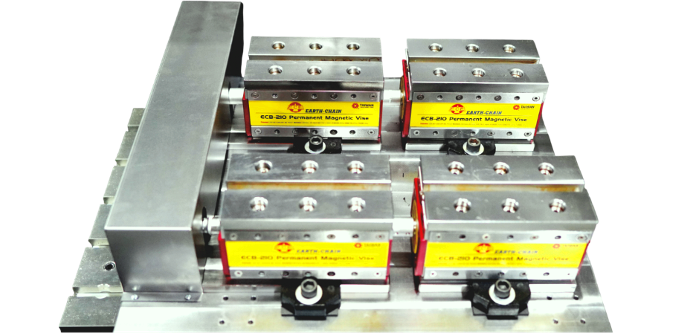
Magnetic clamping blocks use powerful magnetic fields—generated by rare-earth magnets or electromagnets within a hardened steel body—to secure ferromagnetic workpieces during machining, grinding, welding, or inspection. Once activated, the magnetic force distributes evenly across the contact surface, providing a strong, uniform grip.
This eliminates the need for conventional mechanical clamps that can obstruct machining access or require significant operator effort.
Types of magnetic clamping blocks:
- Permanent lifting magnet: Energy-free holding, switched ON/OFF by a lever or cam.
- Electro Permanent Magnetic Chuck: Adjustable holding force via electrical current, ideal for integration with CNC automation and robotic systems.
Their versatility makes them particularly valuable in precision metalworking, where surface accessibility and repeatability are key.
Strengths and Considerations
Key advantages:
- Speed & Efficiency: Instant clamping and release reduce setup time significantly. (Spreitzer)
- Surface Accessibility: Allows unobstructed machining since clamps do not cover the workpiece.
- Uniform Force: Even clamping force reduces deformation risks. (SCHUNK)
- Clean Setup: Minimal fixture hardware, reducing interference and improving workflow.
Points to consider:
- Material Suitability: Best performance is achieved with ferromagnetic materials such as steel or iron, while other materials may require alternative workholding methods.
- Force Range: Extremely heavy, irregular, or thin-walled parts may call for additional support or different clamping approaches.
- Power Needs: Electromagnetic types require continuous power, while permanent magnets avoid this but lack dynamic force adjustment.
Magnetic vs. General Clamping Blocks
| Feature | Magnetic Clamping Block | General Clamping Block (Mechanical) |
| Setup Speed | Very fast (instant ON/OFF) | Slower, requires manual adjustment |
| Surface Access | Full access; no obstruction | May block machining paths |
| Clamping Force | Even distribution, ideal for flat parts | Strong, adaptable to irregular shapes |
| Material Compatibility | Optimized for ferromagnetic materials | Universal (metal, non-metal) |
| Automation Integration | Easily compatible with CNC/robots | Requires manual handling |
Conclusion
In automated machining environments, especially within metal precision processing, magnetic clamping blocks have proven to be a highly effective workholding solution. They combine rapid setup, unobstructed surface access, and reliable holding force, making them ideal for high-precision, high-throughput operations.
While general clamping blocks remain versatile and indispensable in many cases, magnetic clamping blocks offer a compelling balance of speed, precision, and convenience. For manufacturers aiming to enhance efficiency and consistency in automated CNC machining, they represent a smart and forward-looking choice.


