
Magnetic Clamping Blocks: Driving Efficiency in Industrial Metalworking

In the realm of automated manufacturing, precision and efficiency are vital—especially in metal precision machining. Imagine an automated CNC cell producing high-tolerance steel components for the automotive or mold industry, where robotic arms handle continuous part loading and unloading. Fixtures in such environments must not only ensure secure holding but also enable rapid and consistent changeovers to maintain productivity. This is where magnetic clamping blocks stand out, delivering a clean, reliable, and time-saving solution for industrial machining operations.

What Are Magnetic Clamping Blocks?
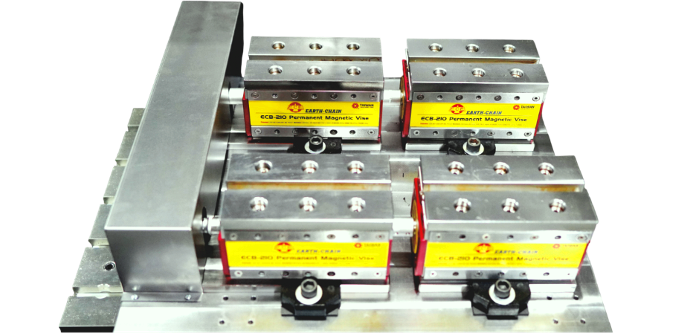
Magnetic Clamping Block

Magnetic clamping blocks use powerful magnetic fields—generated by rare-earth magnets or electromagnets within a hardened steel body—to secure ferromagnetic workpieces during machining, grinding, welding, or inspection. Once activated, the magnetic force distributes evenly across the contact surface, providing a strong, uniform grip.

This eliminates the need for conventional mechanical clamps that can obstruct machining access or require significant operator effort.

Types of magnetic clamping blocks:

Their versatility makes them particularly valuable in precision metalworking, where surface accessibility and repeatability are key.

Strengths and Considerations

Key advantages:

  • Speed & Efficiency: Instant clamping and release reduce setup time significantly. (Spreitzer)
  • Surface Accessibility: Allows unobstructed machining since clamps do not cover the workpiece.
  • Uniform Force: Even clamping force reduces deformation risks. (SCHUNK)
  • Clean Setup: Minimal fixture hardware, reducing interference and improving workflow.

Points to consider:

  • Material Suitability: Best performance is achieved with ferromagnetic materials such as steel or iron, while other materials may require alternative workholding methods.
  • Force Range: Extremely heavy, irregular, or thin-walled parts may call for additional support or different clamping approaches.
  • Power Needs: Electromagnetic types require continuous power, while permanent magnets avoid this but lack dynamic force adjustment.

Magnetic vs. General Clamping Blocks

FeatureMagnetic Clamping BlockGeneral Clamping Block (Mechanical)
Setup SpeedVery fast (instant ON/OFF)Slower, requires manual adjustment
Surface AccessFull access; no obstructionMay block machining paths
Clamping ForceEven distribution, ideal for flat partsStrong, adaptable to irregular shapes
Material CompatibilityOptimized for ferromagnetic materialsUniversal (metal, non-metal)
Automation IntegrationEasily compatible with CNC/robotsRequires manual handling

Conclusion

In automated machining environments, especially within metal precision processing, magnetic clamping blocks have proven to be a highly effective workholding solution. They combine rapid setup, unobstructed surface access, and reliable holding force, making them ideal for high-precision, high-throughput operations.

While general clamping blocks remain versatile and indispensable in many cases, magnetic clamping blocks offer a compelling balance of speed, precision, and convenience. For manufacturers aiming to enhance efficiency and consistency in automated CNC machining, they represent a smart and forward-looking choice.

Earth-Chain: Magnetic Workholding Equipment Producing Specialist

Established in 1988, Earth-Chain Enterprise Co., Ltd. has manufactured magnetic workholding equipment for years, and won the 16th Taiwan Excellence Award. With the development of industrial magnetic application, we have researched on designing a high-performance magnetic workholding machine for many years. Now our magnetic workholding systems have been proved to be able to reduce setup times and provide flexible workholding solutions.


Earth-Chain’s MagVise magnetic workholding holds all ferrous materials for general milling or other types of machine operations. It helps company to build an efficiency process. And we have several typical series here, including electro-permanent magnetic chuck, and electro-permanent magnetic index table. These magnetic workholding machines are suitable for big size of workpiece, CNC horizontal, horizontal milling & boring, etc. And we have “Special Made EEPM Chucks” for special custom needs, which is suitable for all size of workpiece.


You can visit the website of Earth-Chain to obtain more details about magnetic workholding. Just click which picture appeals to you, and welcome to contact us if you still need further information. We are glad for having the chance to provide you solutions.


Here’s a wonderful Magnetic Workholding that would hold firmly our double-win business relationship.


Earth-Chain Enterprise Co., Ltd.

No.551, Sec. 1 Gangbu Rd., Wu-Chi, Taichung 43546, Taiwan (R.O.C)

Tel: 886-4-2630-3737

Fax: 886-4-2630-3636

Email: ece@earth-chain.com.tw, www.earth-chain.com.tw


Magnetic Workholding: Faster Setup and Improved Productivity

If reduced setup times and increased productivity are critical to your operational success, then you should consider making the change to magnetic workholdings.

Magnetic workholding overcomes many of the intrinsic problems associated with the manual clamping of components by multiple vises, toe clamps, strap clamps or other forms of tactile workholding. But the benefits extend well beyond the shop floor where ease of use and quick changeovers rule the workday. Improved ROI and productivity are two bottom-line benefits this type of workholding solution.

Magnetic Workholding Essentials

Workholding magnets are an alternative to mechanically holding work-pieces in machining operations. They are constructed of a series of magnetic poles, pods, set up blocks, pole extenders, or modules. As more pole pieces make contact with a work-piece, a stronger magnetic clamping force results. They are controlled in such a way that clamping power is both uniform and instantaneous.

These workholders use either permanent or electro-permanent magnets. The permanent magnet workholder does not require power while the electro-permanent magnet uses power in order to energize the magnet via an electronic control. This electric power is only used during start up, so a continuous supply of electricity is unnecessary, hence, power outages or brownouts are never a safety issue. Depending upon the application, workholders using magnets can exert a uniform and instantaneous clamping force of 12 tons per square foot. Recent advances in magnetic materials have increased their clamping power while reducing their footprint.

Magnetic Workholding on the Shop Floor

Reduced setup times and faster changeovers are two benefits that this type of workholding brings to the shop floor. Unlike mechanical clamping that requires adjustment, there’s no need to adjust the workholders so time is saved. But the benefits do not stop there.

Vibration reduction is a complementary benefit. Since the magnetic clamping force is instantaneous and uniform, vibrations are minimized. With less vibration, work-pieces are machined with greater precision, more repeatability, less scrap or rework, and less deformation of cutting tools.

Operational and Economic Benefits

Because of their intrinsic benefits, magnetic workholders are a boon to productivity. Fifty percent reduction in setup time has been attributed to this type of workholding in some instances. Cycle time improvements from less vibration and uniform holding force are added benefits causing an extension of tool life and spindle up-time. These benefits translate to better profit margins and ROI paybacks in record time. The technology of practical magnetic workholding is in place now.

DocMagnet Inc. designs and supplies Magnetic Workholding equipment. DocMagnet Magnetic Chucks have all metal surfaces and are built and tested to the highest quality.

Article Source: http://EzineArticles.com/?expert=Patrick_Stox