Selecting Plasma Welding Machines

Plasma welding machines have become quite popular today. These machines have reduced their price also. There are many who are going out to purchase plasma cutting machines today. The machines cut electrically conducting metal with the help of a high velocity ionized gas that is brought out of a nozzle. The high velocity of ionized air turns into plasma as they conduct electricity from the nozzle. This plasma is used to cut the metal sheet as it comes into contact with it. The metal sheet is melted and cut along the desired line of cut with the help of this machine. This process is widely used in the industry today. This is a perfect method of cutting steel and non-ferrous material. This method is used by amateurs today too as it is easy and much more efficient than normal cutting tools.

There are certain guidelines that you should stick to when you are going to purchase a plasma cutting tool. Not only will this enhance your knowledge about the product but it will also help you make an informed decision about the product that you are going to purchase. The first factor that you need to consider when you are buying such a tool is the thickness of the material that you are going to be working with. For a material with high thickness you should go for a machine that has a high amperage rating. The higher the amperage rating the thicker metal you can cut. However, if you are working with thin sheets of metal then you can go ahead with a low amperage machine. The next thing that you should remember is the cutting speed or the production rate. If you require high rates of production or high cutting speeds, then you should go for a machine that has again, a high amperage rating. Lower amperage rating would mean lower cutting speeds. However, in thinner metal cuts, the quality of the cut is reduced. The optimal cutting speed would be obtained from a machine that has high amperage rating.

The pilot arc of the plasma welding machine often conducts with the air to produce high frequency. This sometimes causes problems with other electrical equipment that are around the machine. Therefore make sure that you manage enough space between the machine and the plasma cutting tool. This will ensure that your other equipment does not get damaged with the electricity that is conducted in the air while the machine is operational.

When selecting a plasma welding machine, you should be sure to view a product demonstration and also make a number of test cuts till you are satisfied with the machine. You should always try to go for a cutting machine that has a high pilot arc. This will give you more control over your work and would increase the quality of the work. Always purchase from a reputed manufacturer. Most of the manufacturers today provide total consumer support so you will have no problem with the machine afterwards.

MAY SHUAY specializes in manufacturing and marketing of high efficient and labor-saving turn key automatic welding equipment. We offer customers the options of laser welding machine, seam welders, precision plasma welding machine, inverter TIG welders, MIG welders and plasma cutting machine. Our variety and complete line of welding machines offer customers a one stop shopping selection. Welcome to browse our website to learn further details about plasma welding machine or other welders. Feel free to contact with May Shuay.

Article Source: http://EzineArticles.com/6108553

Packaging Machinery: Bottle Rinser – About Bottling Beverages Packaging

From bottled water to sports drinks, juices, spirits and soda, there are a multitude of thirst quenching products on the shelves from which consumers can choose. But the way those products make their way into the bottles can vary depending on a number of different factors. Below are a few of the beverage choices available to the thirsty consumer, along with a brief explanation of some of the common machinery used to package the products.


Bottled Water


Arguably, one of the simplest packaging lines to create is the bottled water line. This is in part because almost all bottled waters are packaged in a nearly identical manner. A typical bottle of water will be packaged in a 16.9 ounce clear plastic bottle, with a flat, screw on cap and a wrap label. Repetition leads to simplicity and efficiency, so that many bottled water packaging systems will look nearly identical.


Bottle rinsers will be used to remove dust and debris from containers before the filling process in most applications. These packaging machines remove contaminants that may be left over from the manufacture of the bottle or that may accumulate during transport or storage of the bottle. Once rinsed, overflow filler can almost always be found after the container cleaning equipment. The overflow filler allows for a level fill on each and every bottle, which can be important when dealing with clear bottles.


Level fills create an appealing shelf appearance when the product reaches the customer. After the fill, either a spindle capper or chuck capper will normally be found, either of which will tighten the screw on cap consistently and reliably. Finally, a pressure sensitive labeling machine will wrap the label around the bottle, again allowing for consistent and reliable packaging. The loading and unloading of bottles may differ, with some using automated equipment and others using manual labor and the water treatment used may vary depending on the source. But the rinse, fill, cap and label applications will almost always be similar to those noted above. Using this basic bottled water system as the norm, we can look at some other popular beverages and the differences that are required when it comes to packaging machinery.


Carbonated Drinks

Carbonated beverages may present the biggest deviation from what we term the norm for this article. The unique filling machine used for carbonation is known as counter pressure filler. In general terms, the counter pressure filler will pressurize the container being filled and replace oxygen with CO2 to keep a beverage fizzy. Adding carbonation to a beverage will normally require a carbonator and a chiller, as low temperatures are also a necessity for carbonation. Other packaging machinery may vary as well, as carbonated beverages are more likely to use a variety of different bottle or can materials, come in various sizes and use different closures. While spindle and chuck cappers might still be used, as well as a pressure sensitive wrap labeler, carbonated beverages may use unique closures and labels that require a different type of machine. However, the biggest difference lies in the filling equipment and the counter pressure filler.


Alcohols or Spirits


Again, with alcohols and spirits the bottle size and shape may differ more than would be seen with bottled water. But surprisingly, much of the equipment may be the same. Overflow fillers can work with alcohol or distilled spirits, though gravity fillers may also be a popular choice. Capping machines may also be unique, in that bartop corkers are popular for corks, T-corks and other stopper type closures. Capsule spinners are also somewhat unique to alcohols and spirits, though they may be seen on olive oils, sauces and some other products. These extra machines will use heat or a spinner (for plastic or tin capsules, respectively) to provide tamper evidence and aesthetic value to the product. The biggest difference, however, will be the sensors used in the vicinity of the fill area on the packaging line. Many distilled spirits lines will use intrinsically safe sensors, floats, pumps and other components near the fill zone, to protect against the flammable properties that come with these products. Remote control panels will also be set up outside the fill area for safety purposes as well.


Thick Beverages and Particulates


Some creamy drinks or drinks with higher viscosities (without carbonation) may require a different type of filling machine, moving away from overflow and gravity fillers. The same is true of beverages with pulp or other particulates, like those found in some juices. Both pump fillers and piston filling machines are manufactured to handle higher viscosity products and the principles allow for particulates to pass through in a consistent manner. Different pump types and piston sizes will be used depending on the particulate size and product fill size. Other than the filling machine, other equipment will stay pretty standard, but will also show more variation than the bottled water line simply due to a wider range of product and package characteristics.


Of course, there are many other beverage types on the market, with new products emerging nearly every day. Other features of beverage packaging lines may include sanitary equipment to keep the product safe, as well as hot fills when pasteurization is necessary. While almost all beverage lines will include some type of bottle rinser or other container cleaning machine, other lines will incorporate unique machinery, such as the capsule spinner for distilled spirits. Though some similarities and consistencies have been pointed out for specific beverages in this article, it is always a good idea to speak directly with the machine manufacturer to ensure that the best equipment is built for and given packaging project.


KWT Machine Systems Co., Ltd. is the leading packaging manufacturer in Taiwan. We provide water and air cleaning systems, those are use in food filling applications to ensure food safety. The bottle rinser can utilize compressed air, wash liquid to clean or sanitize your containers prior to filling. If you have any interest in bottle rinser, welcome to browse our website or contact with KWT via email or phone.


Article Source: http://EzineArticles.com/8490351

Different Dyeing Methods for Textile Dyeing

Textile dyeing, which is color applied to fabric by different methods of dyeing for different types of fiber and at different stages of the textile production process. Dyeing can be done during any stage in the textile manufacturing process. Textiles may be dyed as fiber, yarn, fabric, or garments, depending upon the type of the fabric or garment being produced.


These methods include:


  1. Direct Dyeing

When a dye is applied directly to the fabric without the aid of an affixing agent, it is called direct dyeing. In this method the dyestuff is either fermented (for natural dye) or chemically reduced (for synthetic vat and sulfur dyes) before being applied. The direct dyes, which are largely used for dyeing cotton, are water soluble and can be applied directly to the fiber from an aqueous solution. Most other classes of synthetic dye, other than vat and sulfur dyes, are also applied in this way.


  1. Stock Dyeing

Stock dyeing refers to the dyeing of the fibers, or stock, before it is spun in to yarn. It is done by putting loose, unspun fibers in to large vats containing the dye bath, which is then heated to the appropriate temperature required for the dye application and dyeing process.


Stock dyeing is usually suitable for woolen materials when heather like color effects are desired. Wool fiber dyed black, for example, might be blended and spun with un-dyed (white) wool fiber to produce soft heather like shade of grey yarn.


Tweed fabrics with heather like color effects such as Harris Tweed are examples of stock dyed material. Other examples include heather like colors in covert and woolen cheviot.


  1. Top Dyeing

Top dyeing is also the dyeing of the fiber before it is spun in to yarn and serves the same purpose as stock dyeing – that is, to produce soft, heather like color effects. The term top refers to the fibers of wool from which the short fibers have been removed. Top is thus selecting long fibers that are used to spin worsted yarn. The top in the form of sliver is dyed and then blended with other colors of dyed top to produce desired heather shades.


  1. Yarn Dyeing

Yarn dyeing is the dyeing of the yarns before they have been woven or knitted into fabrics. Yarn dyeing is used to create interesting checks, stripes and plaids with different-colored yarns in the weaving process. In yarn dyeing, dyestuff penetrates the fibers in the core of the yarn.


There are many forms of yarn dyeing:

  • Skein (Hank) Dyeing
  • Package Dyeing
  • Warp-beam Dyeing
  • Space Dyeing


  1. Skein (Hank) Dyeing

Skein dyeing consists of immersing large, loosely wound hanks (skeins) of yarn into dye vats that are especially designed for this purpose. Soft, lofty yarns, such as hand knitted yarns are usually skein dyed. Skein dyeing is the most costly yarn-dye method.


  1. Package Dyeing

In package dyeing the yarn is wound on a small perforated spool or tube called a package. Many spools fit into the dyeing machine in which the flow of the dye bath alternates from the center to the outside, and then from the outside to the center of the package. Package dyed yarns do not retain the softness and loftiness that skein-dyed yarns do. They are however satisfactory and very widely used for most types of yarns that are found in knitted and woven fabrics.


  1. Warp Beam Dyeing

Beam dyeing is the much larger version of package dyeing. An entire warp beam is wound on to a perforated cylinder, which is then placed in the beam dyeing machine, where the flow of the dye bath alternate as in the package dyeing. Beam dyeing is more economical than skein or package dyeing, but it is only used in the manufacture of woven fabrics where an entire warp beam is dyed. Knitted fabrics, which are mostly produced from the cones of the yarn, are not adaptable to beam dyeing.


  1. Piece Dyeing

The dyeing of cloth after it is being woven or knitted is known as piece dyeing. It is the most common method of dyeing used. The various methods used for this type of dyeing include jet dyeing. Jig dyeing, pad dyeing and beam dyeing.


  1. Garment Dyeing

Garment dyeing is the dyeing of the completed garments. The types of apparel that can be dyed are mostly non-tailored and simpler forms, such as sweaters, sweatshirts, T-shirts, hosiery, and pantyhose. The effect on sizing, thread, zippers, trims and snaps must be considered. Tailored items, such as suits or dresses, cannot be dyed as garments because the difference in shrinkage of the various components and linings distort and misshapen the article.


Garment dyeing is done by placing a suitable number of garments (usually about 24 sweaters or the equivalent, depending on the weight) into large nylon net bag. The garments are loosely packed. From 10 to 50 of the bags are placed in large tubs containing the dye bath and kept agitated by a motor – driven paddle in the dye tub. The machine is appropriately called a paddle dryer.


Of these Direct dyeing and Yarn Dyeing methods are the most popular ones.


Tong Geng Enterprise Co., Ltd. is specializes in design and manufacturing of dyeing equipment for fabric dyeing and yarn dyeing. With over 30 years of solid experience, Tong Geng is one of the leading and skilled suppliers in the world. If you are interested in learning more information about textile dyeing and dyeing machines, welcome to browse our website or contact with Tong Geng directly!


Article Source: http://textilelearner.blogspot.tw/2011/12/methods-of-dyeing-different-dyeing.html


Taichung, TAIWAN- TIMTOS 2017 – SHUZTUNG MACHINERY NEW MODEL LAUNCHED – 3D LASER CUTTING, BENDING MACHINE, ROBOT CELL

Shuztung Machinery, a leading company of manufacturing various machinery and automation equipment launching a brand new 3D laser cutting equipment.


Brand new 3D laser cutting machine has launched by Shuztung Machinery in 2017.


More than 40 years of experiences in machine equipment developing and manufacturing, Shuztung Machinery is one of the leading companies in manufacturing turn-key equipment for bicycles, tube/pipe benders, end forming machines…etc. Machines do not only sell to Taiwanese customers, but also mainly for worldwide markets with high reputation. More than 1000 items are sold around the world.


In 2017, Shuztung Machinery has developed a brand new model, RLS-1000, 3D laser cutting machine which is a new innovation system including 8 axes robot system and IPG laser cutting head to be worked for various cutting of angels, curvature, curve, and irregular shapes. For different industries, such as Automotive, Aerospace, Bicycles, Motorcycles, 3D industry, and Conventional industry. For different materials, like carbon steel, CRMO steel, stainless, titanium alloy, aluminum alloy…etc.


Together with bending machine and robot for transferring, Shuztung Machinery is demonstrating an auto cell system with 3D laser cutting machine in 2017 TIMTOS exhibition. Welcome to visit us at the show for more information.


2017 TIMTOS Exhibition

Date: March 7th to 12th, 2017

Booth: C1200


COMPANY NAME: SHUZTUNG MACHINERY CO., LTD

CONTACT PERSON: JOY HUANG

TEL: +886-4-26831886

EMAIL: joy_huang@shuztung.com.tw

WEBSITE: WWW.SHUZTUNG.COM

Why to Use a Gearbox and How to Select It?

With the many industrial gearboxes available today, it’s important to match the proper type of gearbox with the drive, motor, and load. When a machine needs a servo system (drive and motor), the gearbox type is critical for accurate and repeatable motion.


Why use a gearbox?


Servomotors often drive loads directly without the need for a gearbox, but in many applications it’s advantageous to use a gearbox between the motor and load.


One main reason to use a gearbox is torque multiplication. It lets designers use smaller servo systems that consume less energy. Instead of buying relatively large servo drives and motors, designer can use smaller components, saving space and money.


Output torque increases in direct proportion to the gear ratio, and top speed of the output shaft decreases. If an application can withstand the reduced speed, a relatively small servo system can supply high torque.


Gearboxes can also address inertia mismatches. For high performance servo systems — those with high dynamic responses or low overshoot, for example – the ratio between the reflected load inertia and motor inertia should be as low as practical, ideally under ten-to-one. A precision gearbox reduces the reflected inertia by the square of the reduction ratio. For instance, using a 25:1 gearbox reduces the load’s reflected inertia by a factor of 625, a significant improvement.


In some cases, gearboxes simply resolve issues relating to mechanical fit. For example, if directly mounting the motor interferes with another mechanical component, a right-angle gearbox may solve the problem.


Compared to most other gear reducers, a precision gearbox provides better accuracy and repeatability. Furthermore, the gearbox’s high efficiency lets it deliver maximum power available from the servo system—features often a necessity in servo applications.


Selecting Gearboxes and Servo Systems


A servo system coupled with a planetary gearbox is expected to provide precise motion, but this requires all components be carefully matched. Although it’s possible to buy the servo drive, motor, and gearbox from different suppliers, it’s not recommended as this requires a great deal of research and comparison to ensure all components will work together. Purchasing components from a single supplier — especially one that has carefully matched the components and will stand behind the specific combination of parts in question—offers several advantages.


The supplier has done all the research and confirms compatibility. Most suppliers will extend a more favorable warranty on such purchases. Plus, they can provide the approved mounting hardware to connect the components.


Some suppliers provide online tools for selecting servo systems and compatible gearboxes, easing the specification effort. These selection guides aid the design and provide specific recommendations for closely matched components that can be purchased as a system. In these cases, engineers can be certain the systems they specify are compatible in all critical areas, and that the components will come with the required mounting bushings and keys.


In fact, some selector tools let designers enter their torque and speed requirements, and then automatically filter a list of available motor-and-gearbox sets. Engineers can enter torque data in metric or imperial values, or the designer can select a particular servomotor size. Designers enter speed data as discrete values, or pick a gear ratio. Finally, the engineer can choose a preferred physical orientation—inline, right-angle gearing, or both.


The resulting list of available systems includes pricing information, a factor often critical to the selection process. After choosing a motor/gear combination, the designer moves to a page with full specifications for the selected servo system, the gearbox, and the combination.


One caveat: Even though a selector can make the specifying process easier, engineers and designers should always verify that a system meets their needs and gets applied correctly.


Accumulated many years of experiences in the mechanical transmission and high-quality manufacturing technology, Jia Cheng Precision Machinery Co., Ltd. was established a professional gearbox production and sales company. “Quality First, Customer Satisfaction First” is the company’s philosophy to continuously improve its production processes, timely and efficiently to provide customers with satisfied services. If you are interested in our gearboxes, welcome to visit the website of Jia Cheng and feel free to contact us to learn more information.


Article Source: http://machinedesign.com/mechanical-drives/how-specify-and-apply-precision-gearboxes-servosystems


Outstanding PVC Shrink Film Machine Manufacturer – Jumbo Steel

Welcome to the professional manufacturer of PVC heat shrink film machines – Jumbo, providing high quality shrink film machines, and also having good reputation with high quality and high efficiency products and the best services. Furthermore, we have strong R&D team to keep improving our heat shrinkable film making machines to meet the highest standard of our clients. JS 336 model PVC shrink film machine is one of the high quality products that Jumbo takes pride in. Having a simple introduction about JS 336 model below:


JS 336 PVC Shrinkable Film Production Equipment
JS 336 PVC Shrink Film Machine

Screw Dia.: 55mm

Lay Flat Width: 200-700 mm

Output: 30-60 kg/hr.


PVC Shrink film offer many excellent benefits, such as glossiness, high transparency, durability, water resistance and easy control of shrinkage. They have been applied to a wide variety of product packaging, such as foodstuff, beverage bottles, sporting goods, etc.


Over 25 years, Jumbo Steel has dedicated itself to the research of production technology for shrink film machine. We have made great improvements in product prescription and machine performance, upgrading the quality and efficiency of PVC shrinkable films. We have a strong background and engineering experience for whole-plant planning and equipment supply. Jumbo Steel PVC shrinkable film production equipment has been sold worldwide, and has earned a reputation for its superior machine and outstanding production know-how.


In addition to supplying the most dependable machinery, we also place emphasis on the technological support and complete production upgrades. This allows our customers to start up or resume production very quickly.


Jumbo Steel has a proven tradition of pursuing excellence and improving the PVC Shrinkable Film industry, and it will continue to develop its engineering capabilities and raise industry standards.


If you need more information about Shrink Film Machine series, welcome to visit the website of Jumbo Steel to learn further details about our products. Any questions you have are also welcomed to contact with us.


Jumbo Steel Machinery Co., Ltd.

No. 4, Road 12, Taichung Industrial Park, Taichung, Taiwan.

Tel: 886-4-23590788(Rep)

Fax: 886-4-23590567

E-mail: sales@jumbosteel.com.tw

What is Die Sinking?

Die sinking is a process used to machine or create a specific size or shape cavity or opening in steel blocks. The openings in the steel blocks can then be used to mold plastic into different shapes. Such openings may also be used when doing forging, either hot or cold, or for coining or die-casting.


Most often, die sinking is used to place names, numbers, and other sources of information onto metal. It can also be used to place such elements on a piece of wood, leather, or many other materials. The process for die sinking is fairly simple and something that anyone can do with a few simple tools. There are also larger machines that can help with the process, but these machines come with a price tag.


The process of die sinking begins by obtaining a piece of sheet metal and cutting out a shape. For instance, the shape may be a shield or name tag. When doing the process of die sinking, it is important to use a piece of sheet metal for the project that is at least 1/64 of an inch (0.4 mm) thick.


Once the shape has been placed on the piece of sheet metal, it will need to be cut out. To do this, a chisel and hammer or otherwise special piece of equipment for cutting sheet metal is used. Once the piece has been cut out, it is necessary to file the rough edges down.


After the shape has been completely cut out, next begins the process of die sinking to add letters and numbers. An outline must be created containing the information intended to put on the piece letter by letter. This outline can be created with a soft leaded pencil and using a group of 1/8 inch (3.17 mm) steel lettering.


Once all the lettering has been applied, it is necessary to sit the steel lettering on top of each of the outlined letters and then pound the letter down into the metal with a hammer. This process will create an indentation in the metal. This process is continued until all the lettering, numbers, and other designs are completed.


When done, the process should have created a piece where the indentation of the metal is personalized. It is possible to enhance the lettering by filling the indentations with some type of colored polymer. This permits the indentation to stand out against the metal.


Excetek is the professional manufacturer of providing die sinking EDM. Our die sinking EDM series are divided into CNC die sinking machines and ZNC die sinking machines, both series feature high quality and high efficiency. The EDM process becomes a common method of making prototype and production parts, especially in the aerospace, automobile and electronics industries. EXCETEK would be your best choice of die sinking EDM manufacturer. Welcome to visit our website and contact EXCETEK for more specifications.


Article Source: http://www.wisegeek.com/what-is-die-sinking.htm


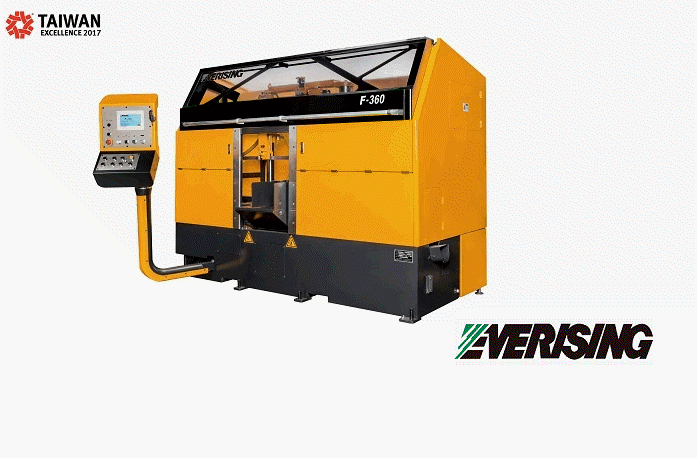
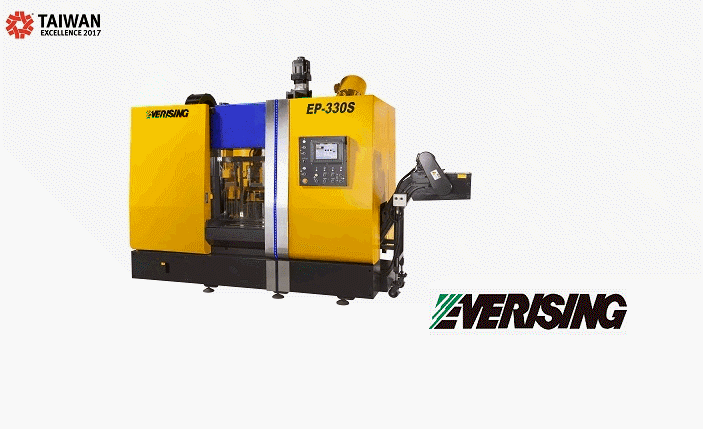
2017 Taiwan Excellence Award: F-360 Fully Automatic Band Saw EP-330S HI-TECH BAND SAW

2016-12-30_134355

↑ Fully Automatic Band Saw (F-360)


b

↑ HI-TECH BAND SAW (EP-330S)

Fully Automatic Band Saw (F-360) and HI-TECH BAND SAW (EP-330S) have been internationally recognized by “25th Taiwan Excellence Award”, excellent cutting stability, sawing the decline of high performance.


EVERISING F-360, the full-cover automatic band saw, is referred the machine from the US and Europe to see how to make the machine look fashion and safety. At the same time, we also think the machine safety and improve the machine to be more energy efficient and environment friendly


EVERISING EP-330S, the hi-tech band saw machine, is referred the machine from the US and Europe to see how to make the machine look fashion. At the same time, we also think the machine safety and improve the machine to be more energy efficient and environment friendly.


For more information, please visit www.everising.com


How to Select the Right Plastic Pelletizing Machine

Pellets may be “only” an intermediate product, but their size, shape, and consistency matter in subsequent processing operations.


This becomes even more important when considering the ever-increasing demands placed on compounders. No matter what equipment they currently have, it never seems suited for the next challenge. An increasing number of products may require additional capacity. A new polymer or additive may be too tough, soft, or corrosive for the existing equipment. Or perhaps the job requires a different pellet shape. In such cases, compounders need in-depth engineering know-how on processing, and close cooperation with their plastic pelletizing machines supplier.


The first step in meeting such challenges begins with equipment selection. The most common classification of pelletizing processes involves two categories, differentiated by the state of the plastic material at the time it’s cut:


  • Melt pelletizing (hot cut):

Melt coming from a die that is almost immediately cut into pellets that are conveyed and cooled by liquid or gas.


  • Strand pelletizing (cold cut):

Melt coming from a die head is converted into strands that are cut into pellets after cooling and solidification.


Variations of these basic processes may be tailored to the specific input material and product properties in sophisticated compound production. In both cases, intermediate process steps and different degrees of automation can be incorporated at any stage of the process.


To find the best solution for your production requirements, start with assessing the status quo, as well as defining future needs. Develop a five-year projection of materials and required capacities. Short-term solutions very often prove to be more expensive and less satisfactory after a period of time. Though almost every plastic pelletizing line at a compounder will have to process a variety of products, any given system can be optimized only for a small range of the entire product portfolio.


Consequently, all the other products will have to be processed under compromise conditions.


The lot size, in combination with the nominal system capacity, will have a very strong impact on the pelletizing process and machinery selection. Since compounding production lots tend to be rather small, the flexibility of the equipment is often a big issue. Factors include easy access for cleaning and service and the ability to simply and quickly move from one product to the next. Start-up and shutdown of the pelletizing system should involve minimum waste of material.


A line utilizing a simple water bath for strand cooling often is the first option for compounding plants. However, the individual layout can vary significantly, due to the demands of throughput, flexibility, and degree of system integration. In strand pelletizing, polymer strands exit the die head and are transported through a water bath and cooled. After the strands leave the water bath, the residual water is wiped from the surface by means of a suction air knife. The dried and solidified strands are transported to the plastic pelletizing machine, being pulled into the cutting chamber by the feed section at a constant line speed. In the pelletizer, strands are cut between a rotor and a bed knife into roughly cylindrical pellets. These can be subjected to post-treatment like classifying, additional cooling, and drying, plus conveying.


If the requirement is for continuous compounding, where fewer product changes are involved and capacities are relatively high, automation may be advantageous for reducing costs while increasing quality. Such an automatic strand pelletizing line may utilize a self-stranding variation of this type of pelletizer. This is characterized by a cooling water slide and perforated conveyor belt that replace the cooling trough and evaporation line and provide automatic transportation into the plastic pelletizing machine.


Some polymer compounds are quite fragile and break easily. Other compounds, or some of their ingredients, may be very sensitive to moisture. For such materials, the belt-conveyor strand pelletizer is the best answer. A perforated conveyor belt takes the strands from the die and conveys them smoothly to the cutter. Various options of cooling—water spray, misters, compressed-air Venturi dies, air fan, or combinations thereof—allow for a good deal of flexibility.


Based on expertise technique, KOWIN designs and manufactures the high quality plastic pelletizing machine. If you need more information about plastic pelletizing line or plastic recycling machines series, welcome to visit our website and feel free to contact KOWIN.


Article Source: http://www.ptonline.com/articles/how-to-select-the-right-pelletizer


The Secrets of Canning Machines

Canned foods are something that almost no one is willing to live without. Ever since the manufacturing of canned foods began in the late 1800’s, people have been relying on them as a way to keep vegetables and fruits for longer periods of time. The invention of the canning machine helped revolutionize this idea making canned foods available on a large scale.


Canning machines took traditional canning from the kitchen to the factory. Instead of using glass canning jars, canning machines typically used aluminum or metal cans to can food for lasting freshness. They are made to withstand canning multiple cans throughout the day without the user having to stop the process to add water to a canning pot. Instead, this machine and others each carry out a process similar to the processors completed within a pressure canning pot.


Canning machines work in stages with each stage corresponding to a step that is carried out within a canning pot. There is a part of the machine that fills the can while another part of the machine seals a can. Afterwards, another part of the canning machine uses heat and pressure to force excess air from the cans prior to a permanent seal being applied to the cans.


There are 3 specific pieces that belong to the canning machine. They are:


  • The Seamer
  • The Filler
  • The Labeler


There are various types of canning machines available on the market today. The type of machine that you buy depends are different factors; amount to be canned, size of the cans, type of food being canned. Although there are some canning machines that can produce canned foods in a variety of sizes, these are more expensive and more prone to breaking down. This is usually the result of canning a variety of sizes throughout the day.


Because they are put under stress and force every day, canning machines tend to be made of reinforced steel making them extremely heavy. This also helps in supporting the machine by providing structural strength that can be used on a long term basis.


Not all canning machines only use metal cans, and there are some using glass jars as well. These machines are made especially for working with glass and shouldn’t be used with metal cans.


Most canning machines are controlled by computers; however, there those which are operated by 2 or more people. These canning machine operators are in control of each aspect of the machine. Training on these machines can take up to 6 months depending on how much time a company is willing to spend on training.


Canning machines can be bought by companies and by individuals. However, they are generally more practical for use in a factory setting because of the size and weight. The average canning machine weighs in excess of 300 pounds. There are also better suited for a factory because of the speed of output which increases profit while lowering cost.


SHIN I Machinery Works Co., Ltd. is a high quality Food Canning Machines manufacturer in the industry. In food canning machines series, we provide automatic seamer and automatic filler for customers. If you are interested in or need further information about canning machines, welcome to visit our website and feel free to send inquiries to SHIN I.


Article Source: http://www.homecanningguide.com/2013/02/the-secrets-of-canning-machines/